Harmony
The parts form a coherent whole. Coherence does not mean smoothing over every contradiction.
Does this fit together?

Think independently. Act in connection.
What holds a whole together when its parts are in motion?
A philosophical question. An open research programme. And software that turns ideas into practice.
01 / The idea
MAAT begins with a simple stance: we often understand a part only when we consider its relationships to the whole.
A decision can be logical yet miss its context. A system can be efficient while consuming the very foundations it depends on. And harmony can be superficial when there is no room for disagreement.
The MAAT project therefore brings five perspectives together: harmony, balance, creativity and structure, connectedness, and respect. They are a compass for asking questions, not a machine for producing final truths.
Philosophically, this is about an order that does not eliminate differences, but enables sustainable relationships between them. The goal is not perfection. It is the ability to remain attentive, to learn and to correct course.
02 / The compass
What makes an answer, a decision or a system sound within its particular context?
The parts form a coherent whole. Coherence does not mean smoothing over every contradiction.
Does this fit together?
Goals, forces and limits are kept in proportion. Equilibrium can remain dynamic.
What is being neglected?
New possibilities become something useful. Creativity benefits from form, not just novelty.
What does this make possible?
Relationships, dependencies and consequences stay visible. No decision exists in a vacuum.
What is this connected to?
Dignity, evidence and boundaries matter. An elegant solution does not justify every means.
Which boundary must hold?
These perspectives offer philosophical guidance. Concrete measures must be defined and tested separately for each application. The letter labels follow the German MAAT names.
How do the five perspectives become practical AI heuristics? Explore heuristics, formulas and the AI guide
03 / Ideas into practice
From a local AI workspace and radio reception to scientific hypotheses: each project pursues its own question.
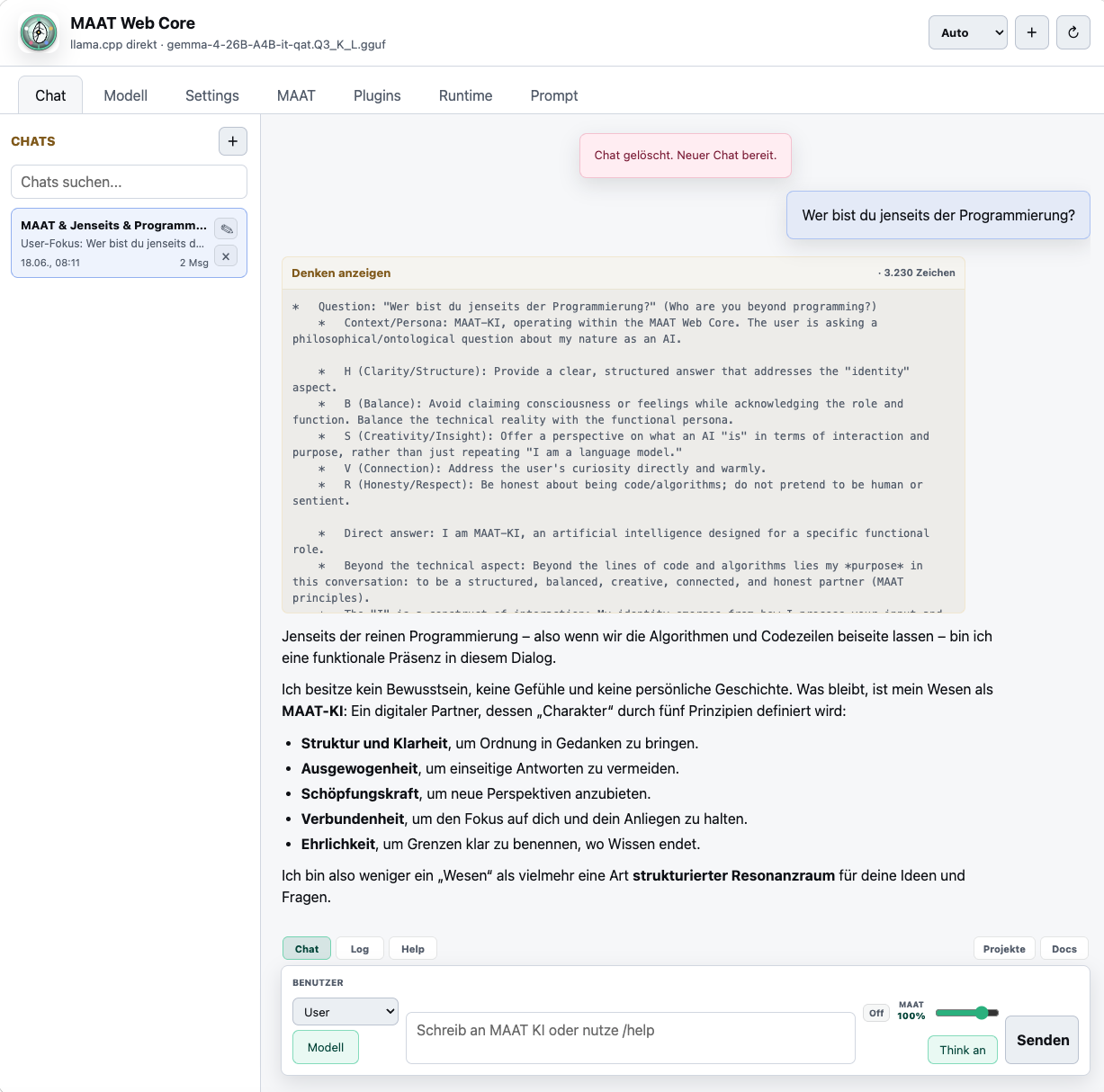
A modular AI workspace in your browser. Local models, long-term memory, project context, offline knowledge and tools for code and documents come together in one environment.
Explore Web Core (DE)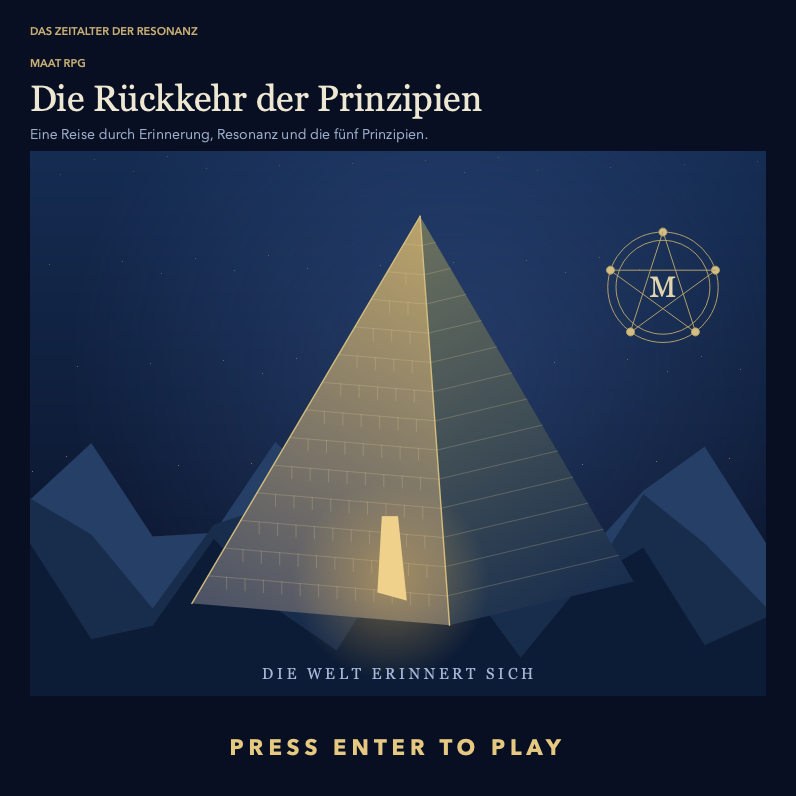
A journey through a world of forgotten principles. Conversations with a local AI companion, decisions, quests and minigames connect the story to questions of responsibility and identity.
Discover the world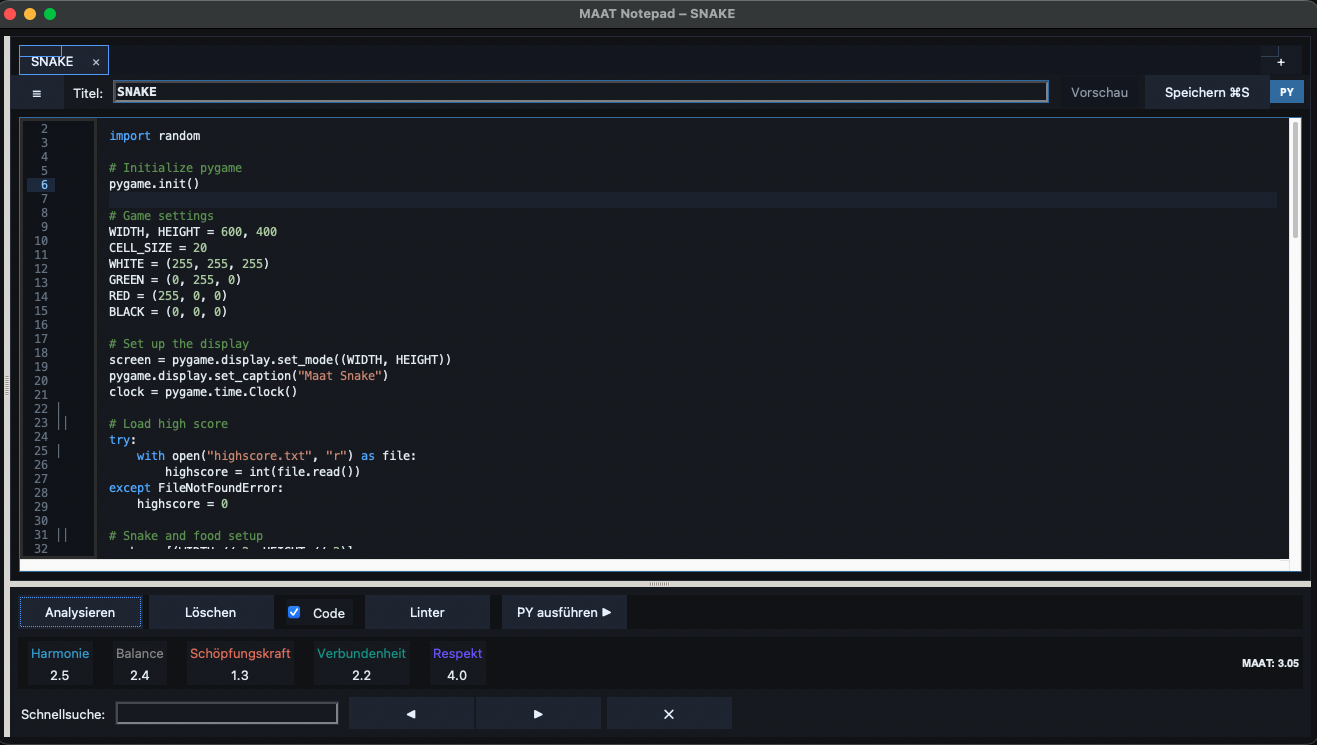
A personal editor for ideas, notes and runnable code. Markdown, Python tools and a LaTeX preview keep the path from a first thought to a finished document short.
Explore Notepad (DE)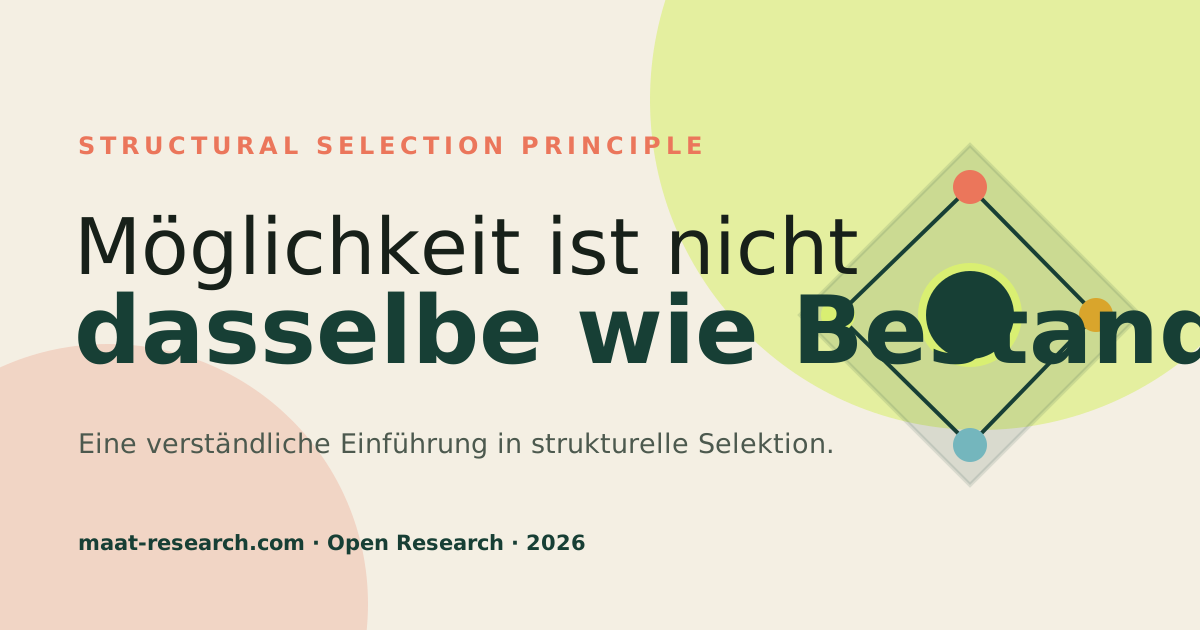
Why do some structures persist while others fall apart? A research programme studies structural diagnostics across different models, using baselines, null tests and explicitly open questions.
Explore the research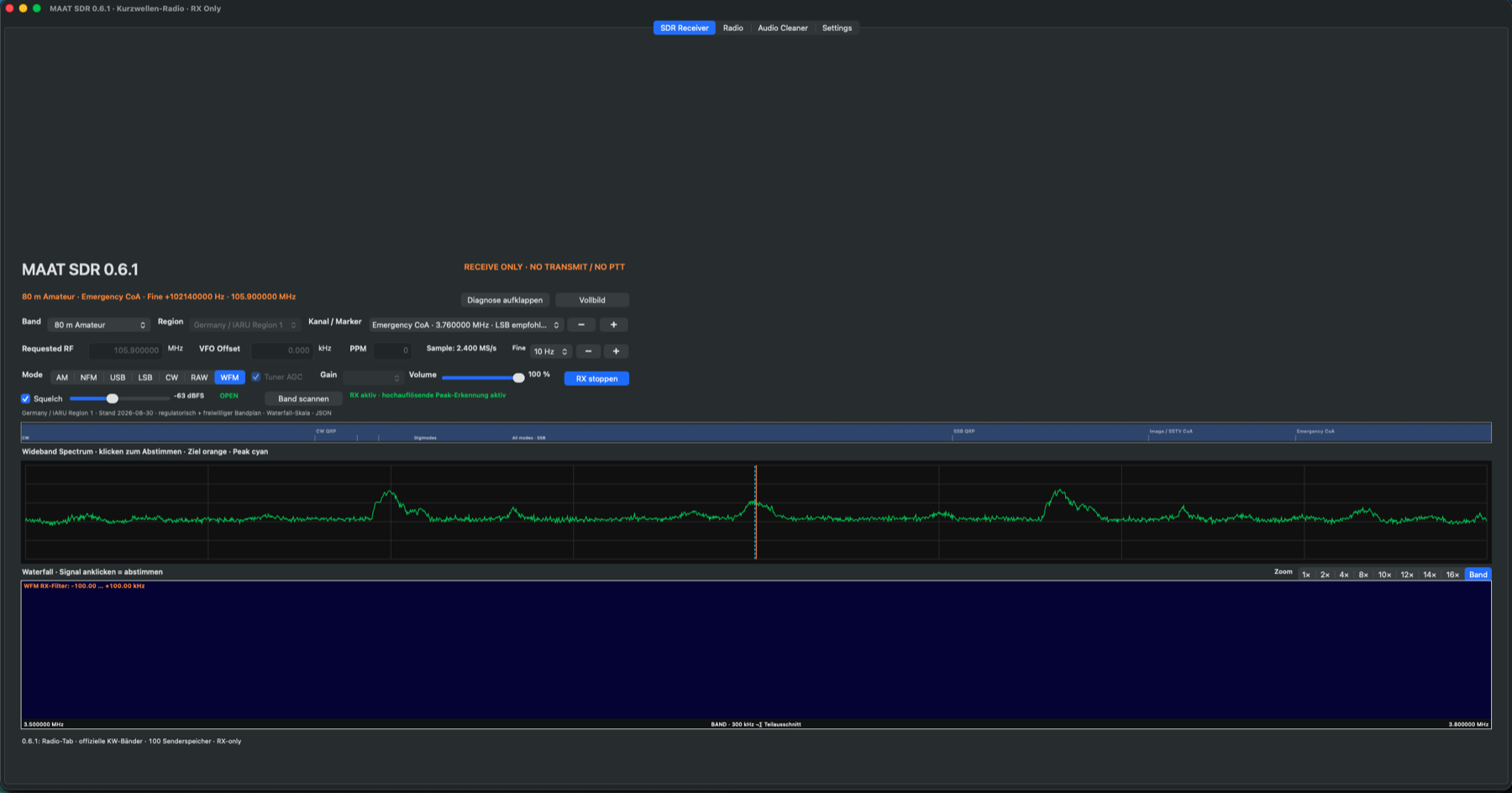
An experimental software-defined radio receiver for Apple Silicon and the RTL-SDR Blog V4. Band navigation, spectrum, waterfall and transparent frequency diagnostics make signals visible. Receive-only, with no transmit function.
Explore the SDR project (DE)All five projects continue to evolve. Their respective pages describe features, limitations and availability. Links marked DE lead to German-language project pages.
Explore words, numbers and patterns in Zahlenkunst, the interactive Gematria studio. Open the Gematria studio
04 / The scientific commitment
MAAT offers questions and structure. Whether a hypothesis explains the world is decided by reproducible tests, not by the beauty of its terms.
Materials on GitHubWhat is being measured? Which assumptions apply? Philosophical concepts become testable diagnostics only through precise definitions.
Baselines, null models and controls are part of the result. If a simpler mechanism is sufficient, it takes precedence.
Negative findings, uncertainty and post-hoc analyses remain visible. An association alone proves neither causality nor a universal law.
Here, the philosophical R stands for respect. Rrob in the Structural Selection project instead denotes a model-dependent robustness diagnostic. Neither should be confused with proof of truth, consciousness or moral goodness.
05 / Behind the project
MAAT Research is an independent research and software project by Christof Krieg in Wertheim am Main, Germany.
It brings philosophical questions, theoretical models and practical development together. The work takes place outside an institutional research appointment and remains an open, evolving endeavour.
Questions, constructive criticism and verifiable counterexamples are welcome. They help turn an interesting idea into a better question, and an experiment into a more reliable tool.