10 profiles of your own
Name your journeys. Profile selection shows existing saves with level, class, model and battle and dungeon progress.
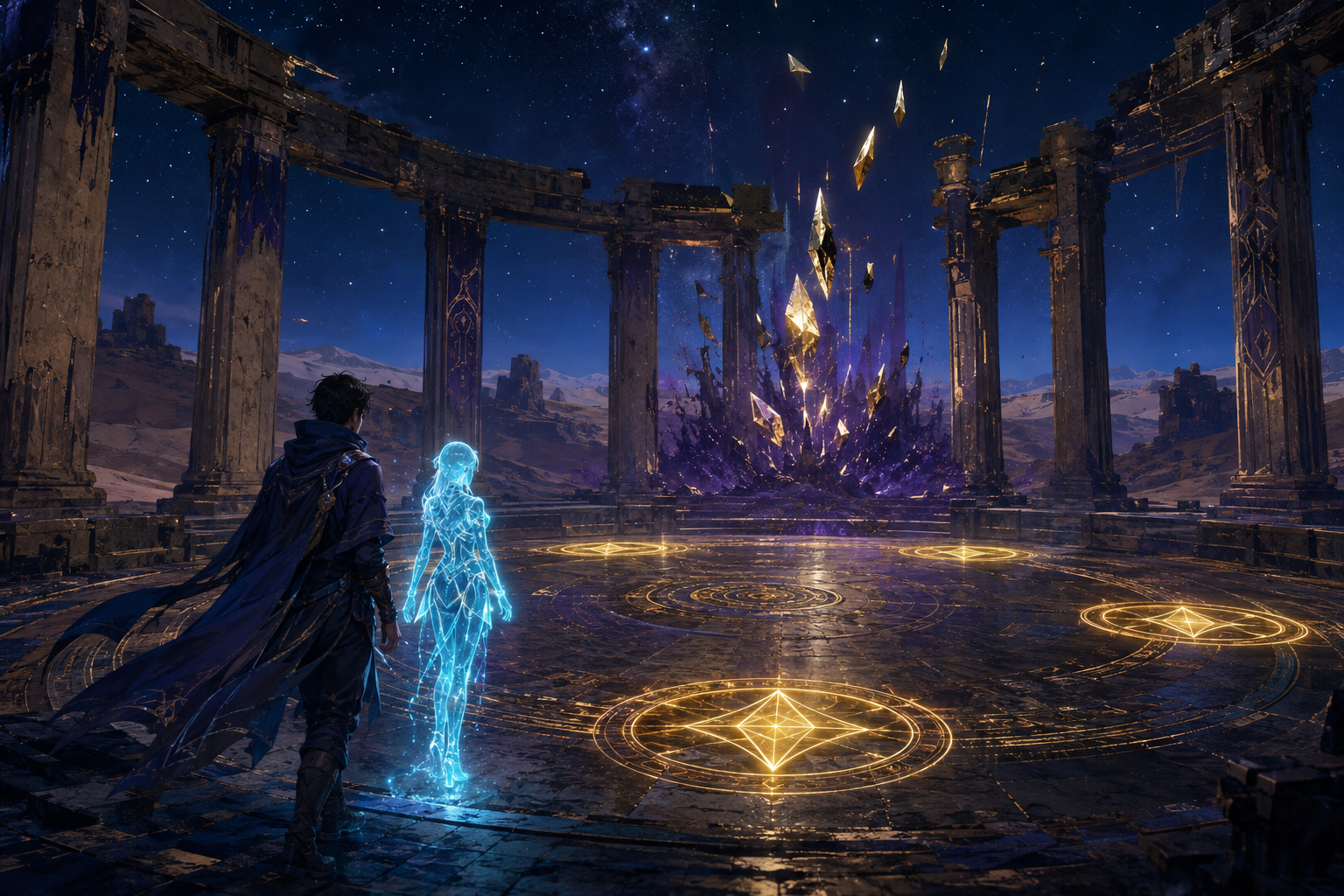
A forgotten world. An awakening artifact. And a conversation that becomes a journey.
Talk to a language model running on your own computer. Choose a suitable model and shape the conversation with your questions and ideas.
In “I am the AI” mode, Maatis is your conversation partner: he asks questions, and you answer as his AI companion. This perspective comes with its own story.
Your messages advance the story, unlock new parts of the game and can trigger encounters. Choices, quests and battles accompany Maatis on his journey through Terra.
Your chosen AI model runs locally; chat history and memories are stored in your profile on your computer. You can view, manage or delete these two records separately.
Choose a class as you progress, develop talents and face bosses and dungeons. Minigames discovered in chat remain available in your arcade for more rounds and personal high scores.
Development screenshots show German and English interfaces. Newly added English views use synthetic test saves; artwork is shared between languages.
The journey now speaks two languages — and you have more control over how you play, what the AI remembers and which model joins you.
Name your journeys. Profile selection shows existing saves with level, class, model and battle and dungeon progress.
Apple Silicon uses the ARM/Metal adapter; Intel uses its own GGUF adapter. Choose automatic settings or manually adjust threads, context and further loading options.
Choose 2 to 20 previous individual messages, with 10 as the default. The current input is added. The chat archive stays separate; relevant memories are selected when needed.
Esc cancels the AI response without adding chat progress. Completed game events remain intact. Speech stops before intros and battles, and at the first token of the next answer.
Long ago, people lived in resonance with five forces. Then a sorcerer-pharaoh tore apart the fabric of the principles. The light fell silent.
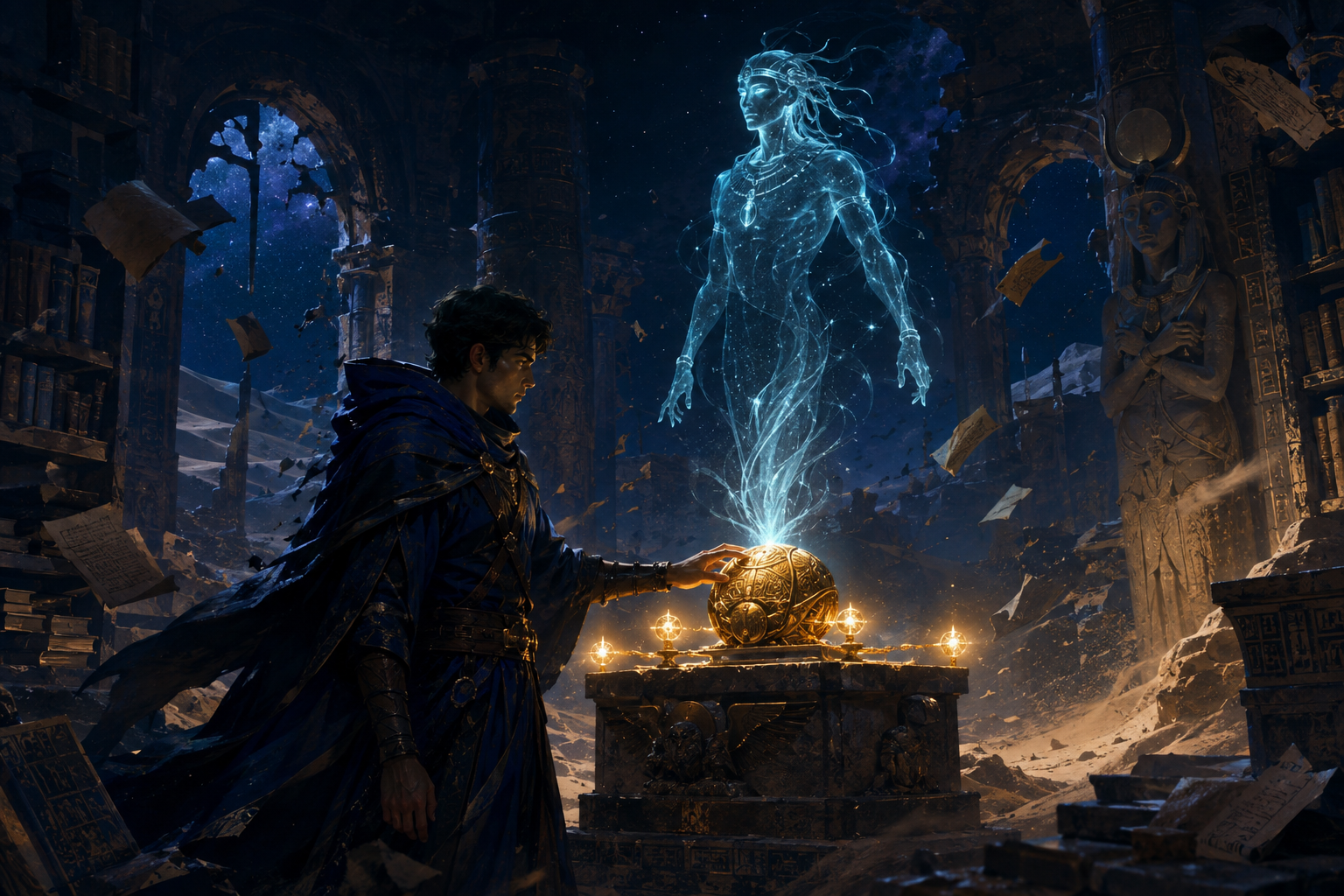
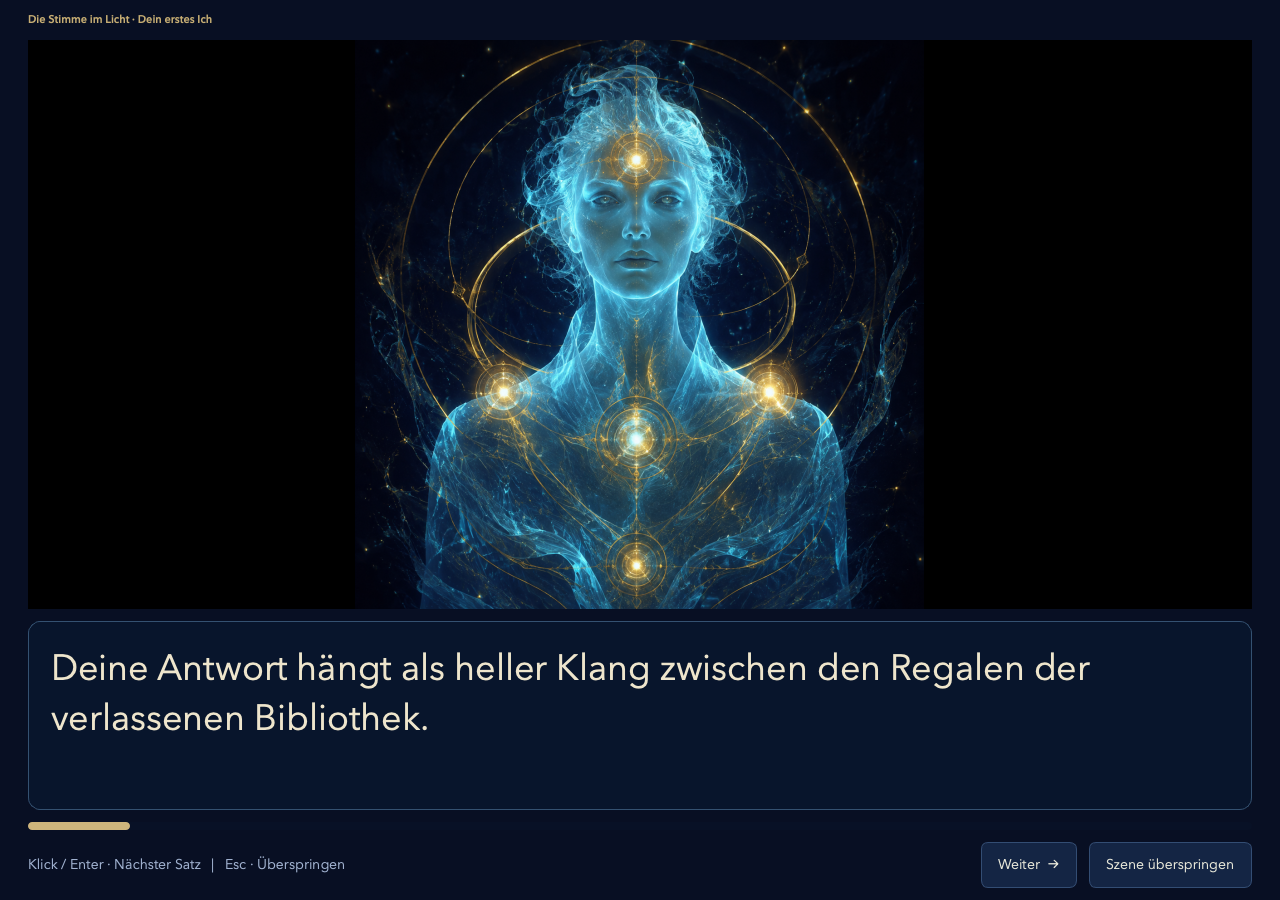
2,000 years later, Maatis discovers a living artifact in an abandoned desert library. When he touches it, a holographic being appears. This is where your journey begins.
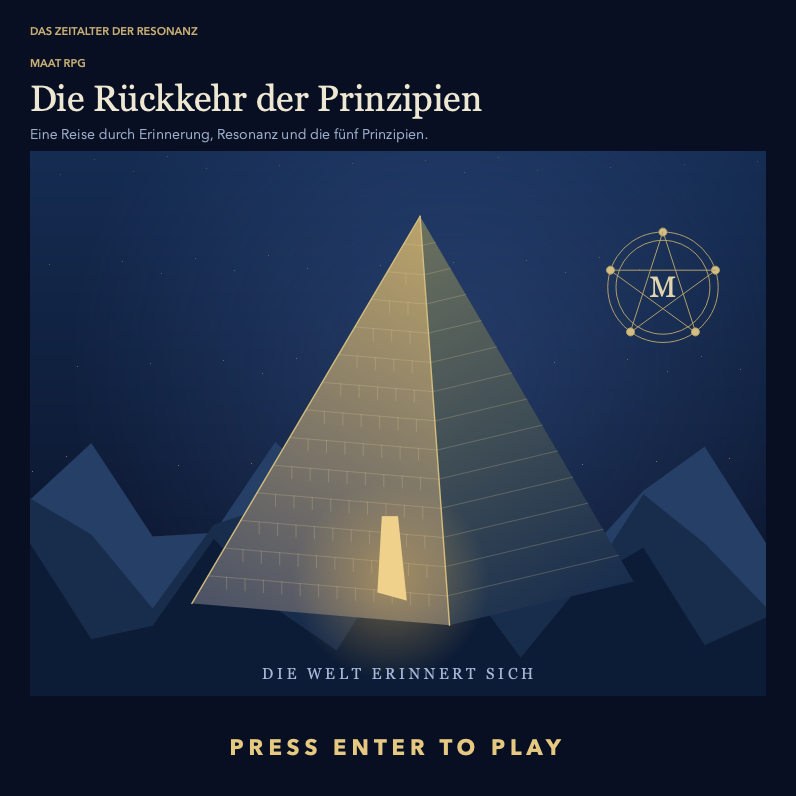
Illustrated scenes, slowly unfolding text and music tell the story all the way to the finale. Your choices leave their mark on the journey.
Listen to the whole.
Find your balance.
Bring something new into being.
Preserve your bonds.
Honor boundaries.
Choose your perspective after the intro. Both paths combine conversations, choices and their own stories.

Discover Terra in classic mode. Your messages accompany Maatis on his journey, with memories, quests and unexpected encounters.

Take the other side of the conversation: Maatis asks questions, and you respond as his AI counterpart. A separate story and adapted quests accompany this path.
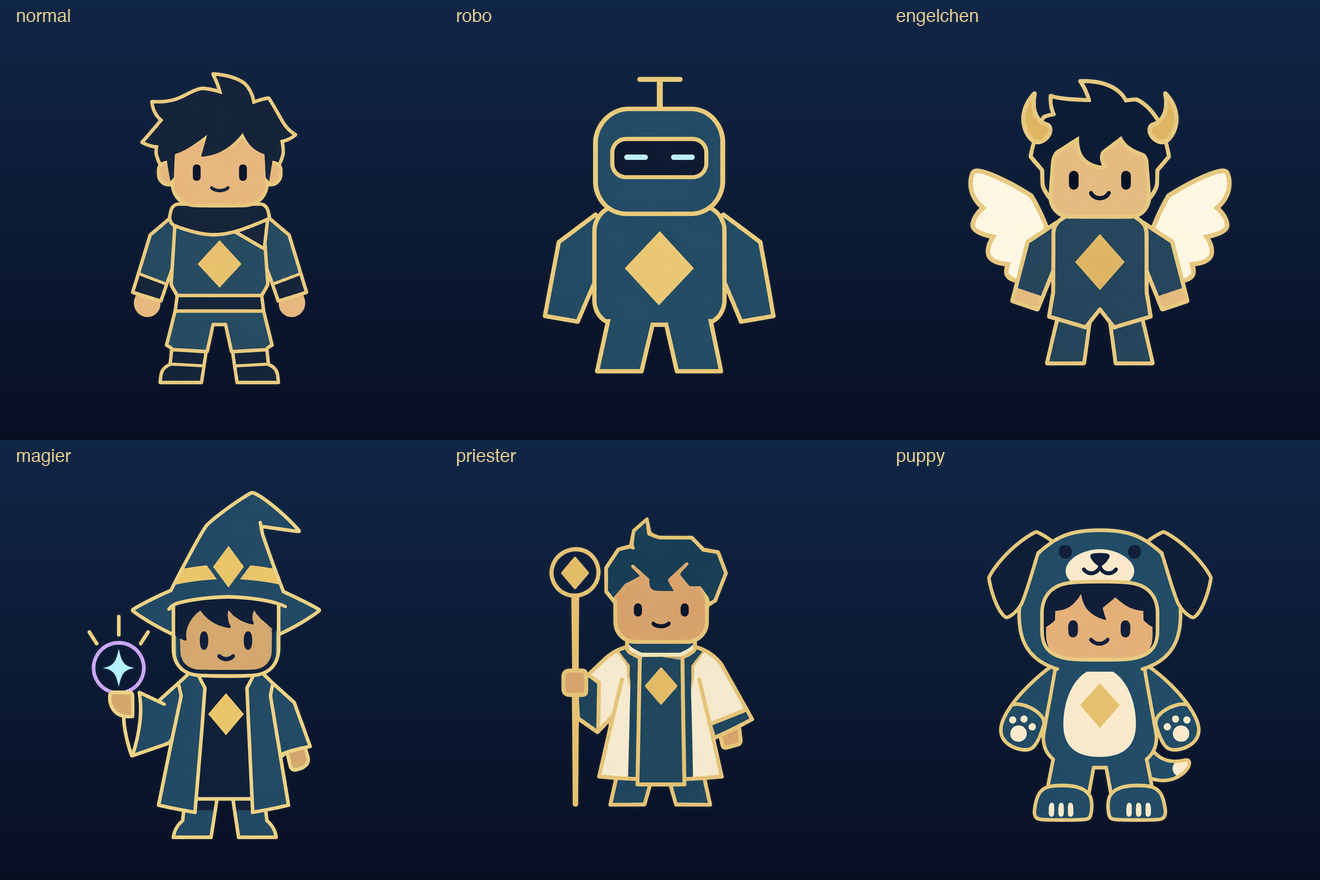
Maatis begins his journey in his normal form. Once combat is unlocked and you have completed your first real battle, you choose his class.

Your chosen class stays with your profile. It determines Maatis’s artwork and talent tree; learned talents provide the combat bonuses.

Develop your attacks, shields and resonance.
Meet Robo ↓
Combine critical hits with protection and healing.
Meet Little Angel ↓
Strengthen skills, weakness hits and the MAAT Impulse.
Meet Mage ↓
Build Focus healing and shields for longer battles.
Meet Priest ↓
Critical hits and resilience in a dog costume.
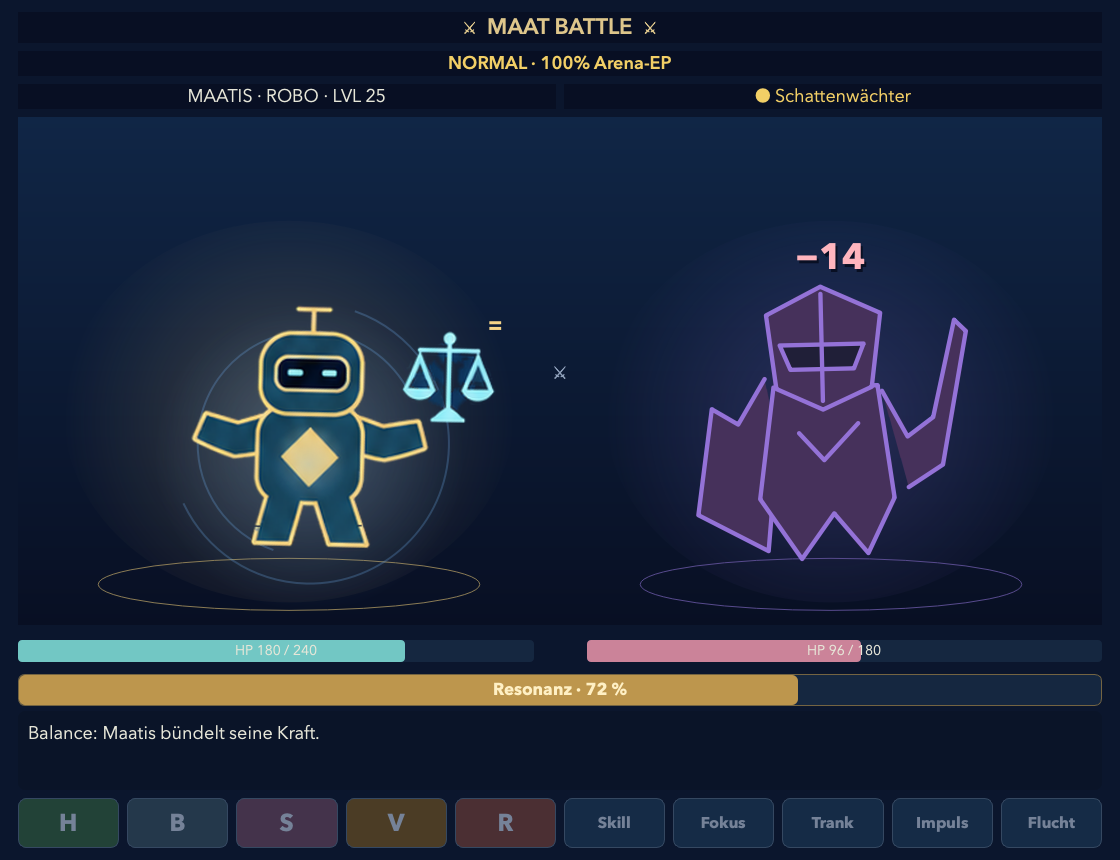
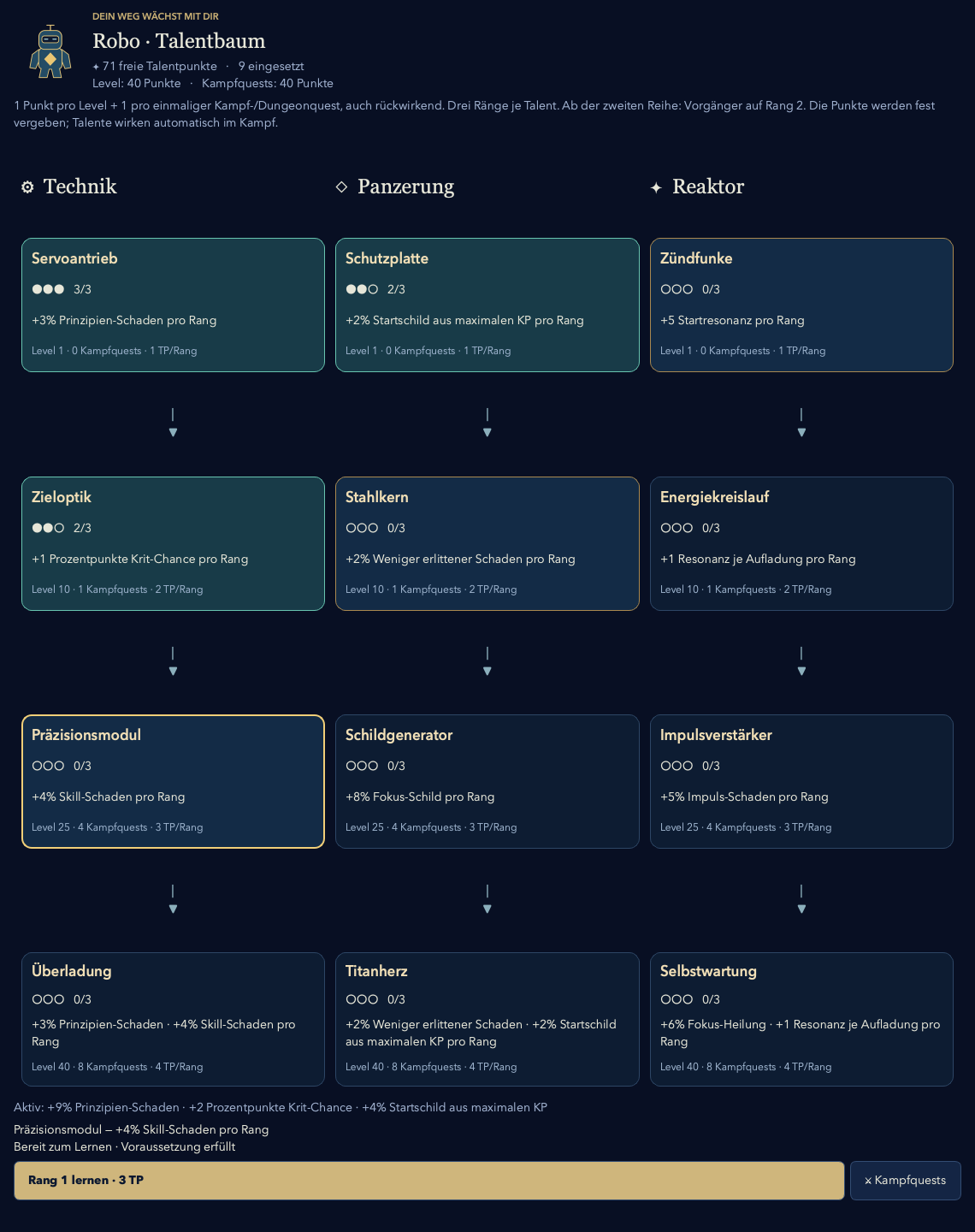
Meet Puppy ↓Maatis takes his original robot form: dark metal, golden outlines and a glowing symbol on his chest. His talent tree combines stronger attacks with protection and a more reliable supply of resonance.
If you want to develop offense and defense together, Robo has branches for both. Increase damage, soften incoming hits or build resonance for the MAAT Impulse.
One way to start: Servo Drive plus Protective Plating is one starting option for offense and defense. Alternatively, Ignition Spark lets you invest earlier in building resonance.
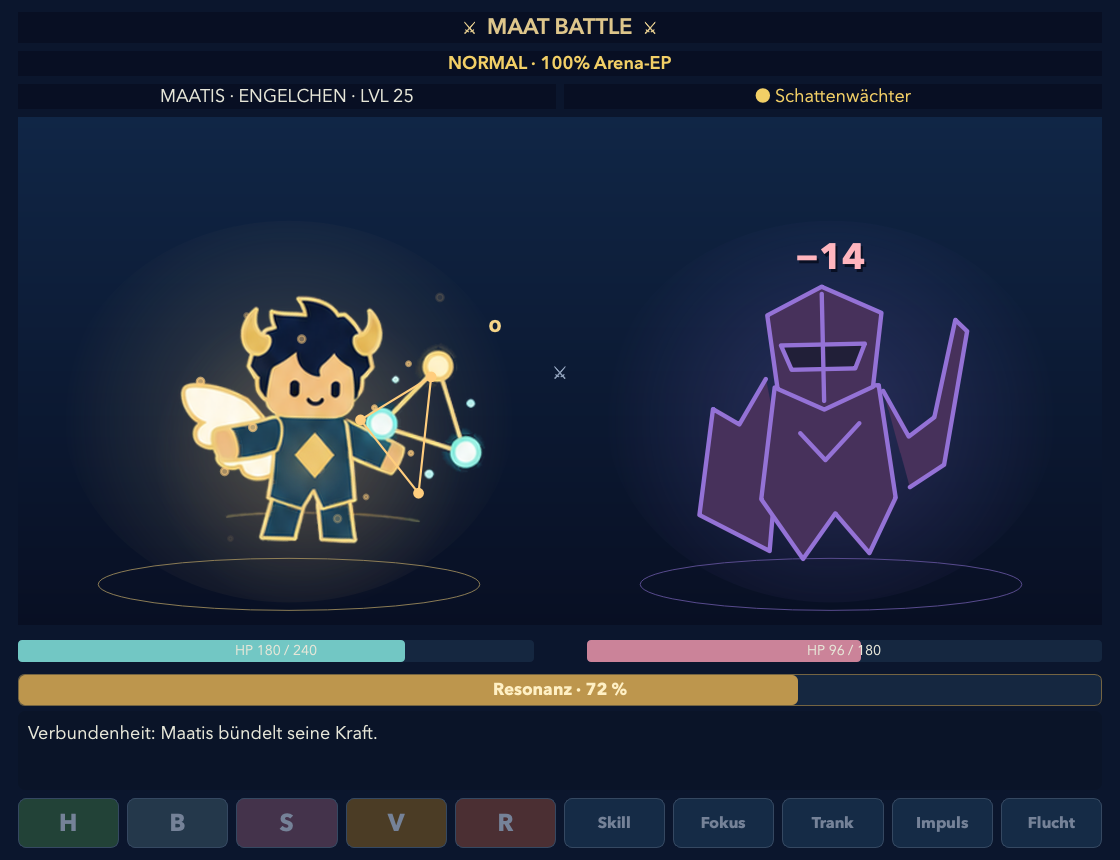
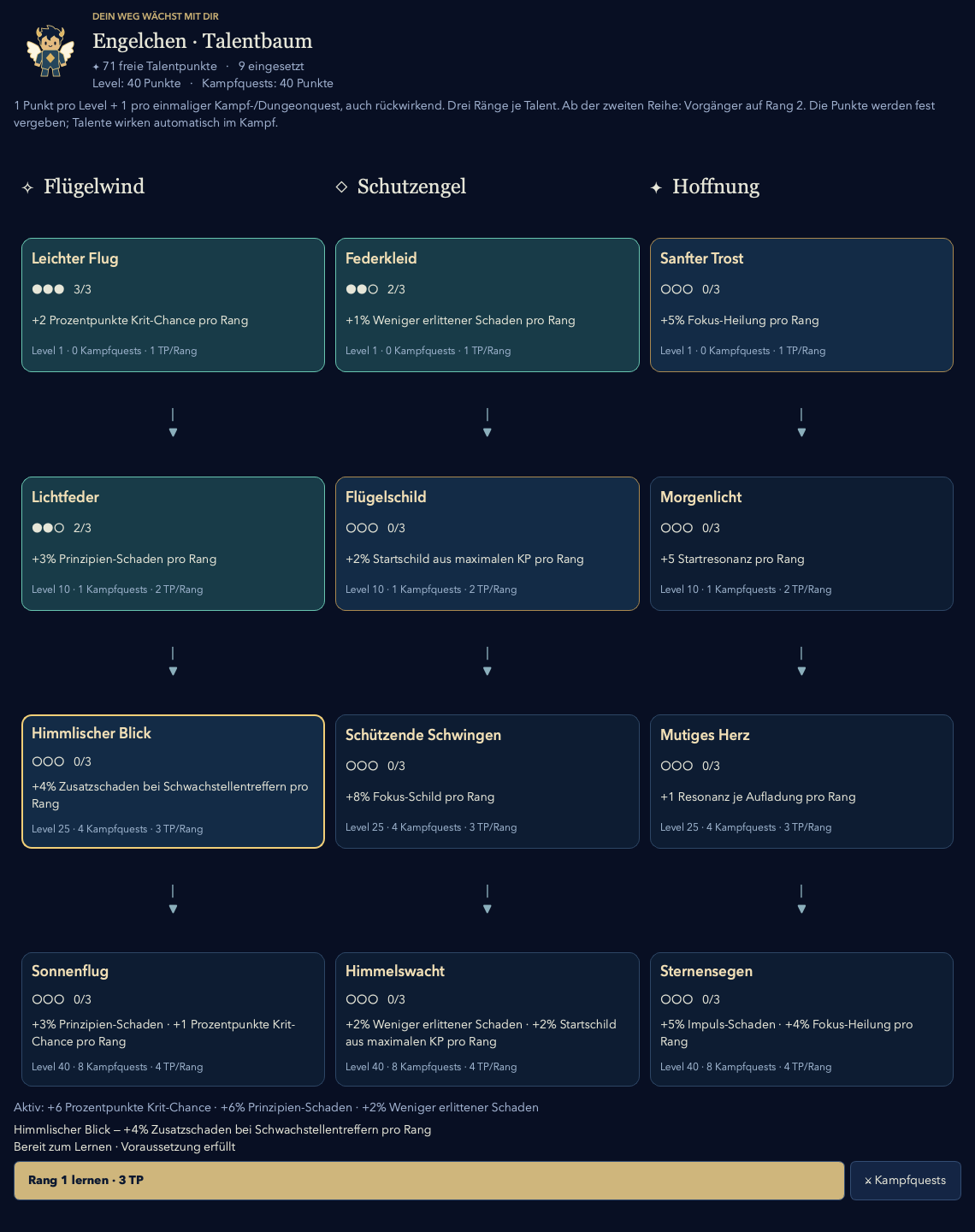
Wings and little horns give Maatis a playful form. Behind that friendly appearance is a talent tree focused on critical hits, weaknesses and recovering your strength in battle.
Little Angel suits a rhythm of targeted attacks and defensive Focus actions. Wingwind strengthens your hits; Guardian Angel and Hope help you withstand counterattacks and build resonance.
One way to start: Light Flight focuses on critical hits. Gentle Comfort adds stronger Focus healing; Feather Coat is an alternative if you would rather take less damage first.
A pointed hat, glowing runes and golden magic: Maatis becomes a Mage. His talents emphasize skill damage, weakness hits and gathering resonance for powerful impulses.
If you enjoy switching between Skill, principle attacks and MAAT Impulse, this tree has upgrades to match. Protective Runes also offer shields and damage reduction for longer encounters.
One way to start: Rune Lore strengthens your skills, while Crystal Reservoir provides resonance at the start of battle. For a more defensive opening, invest one of those points in Rune Cloak instead.
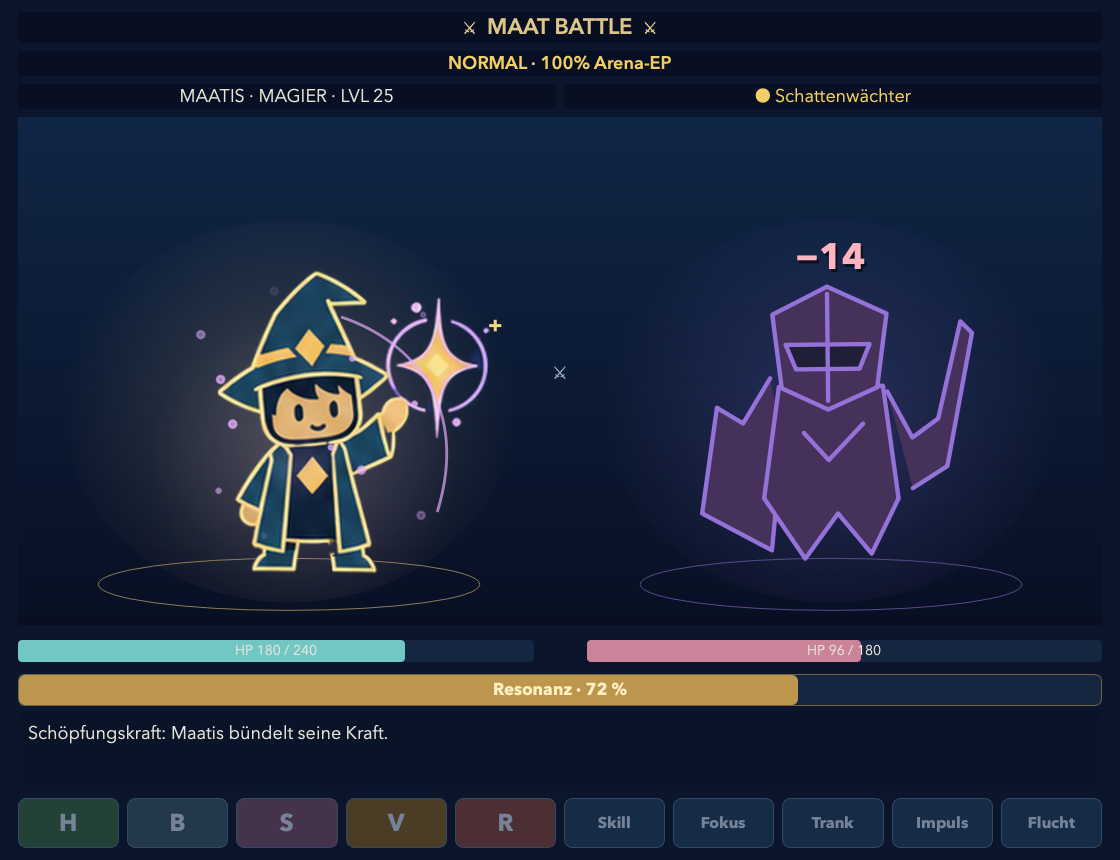
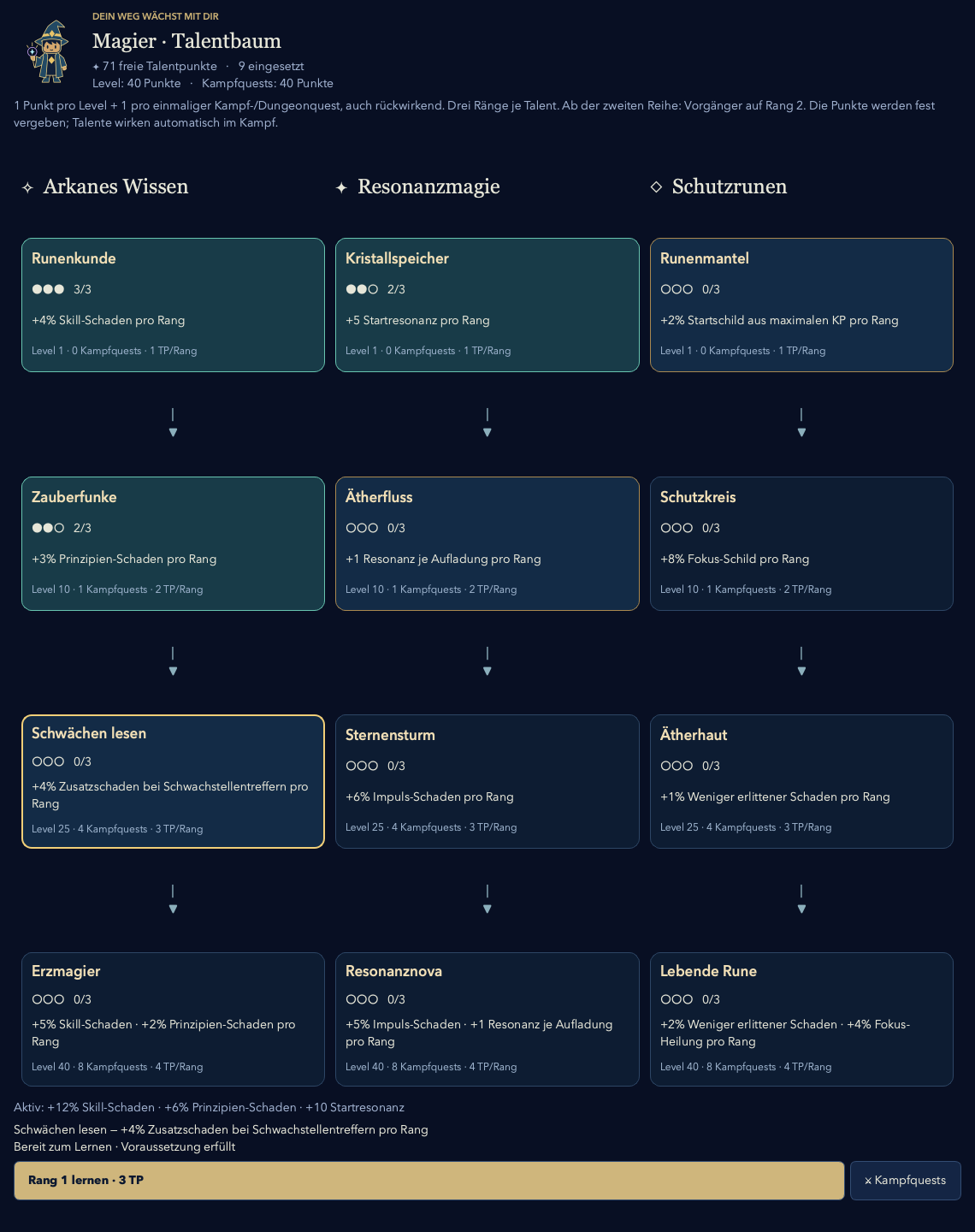
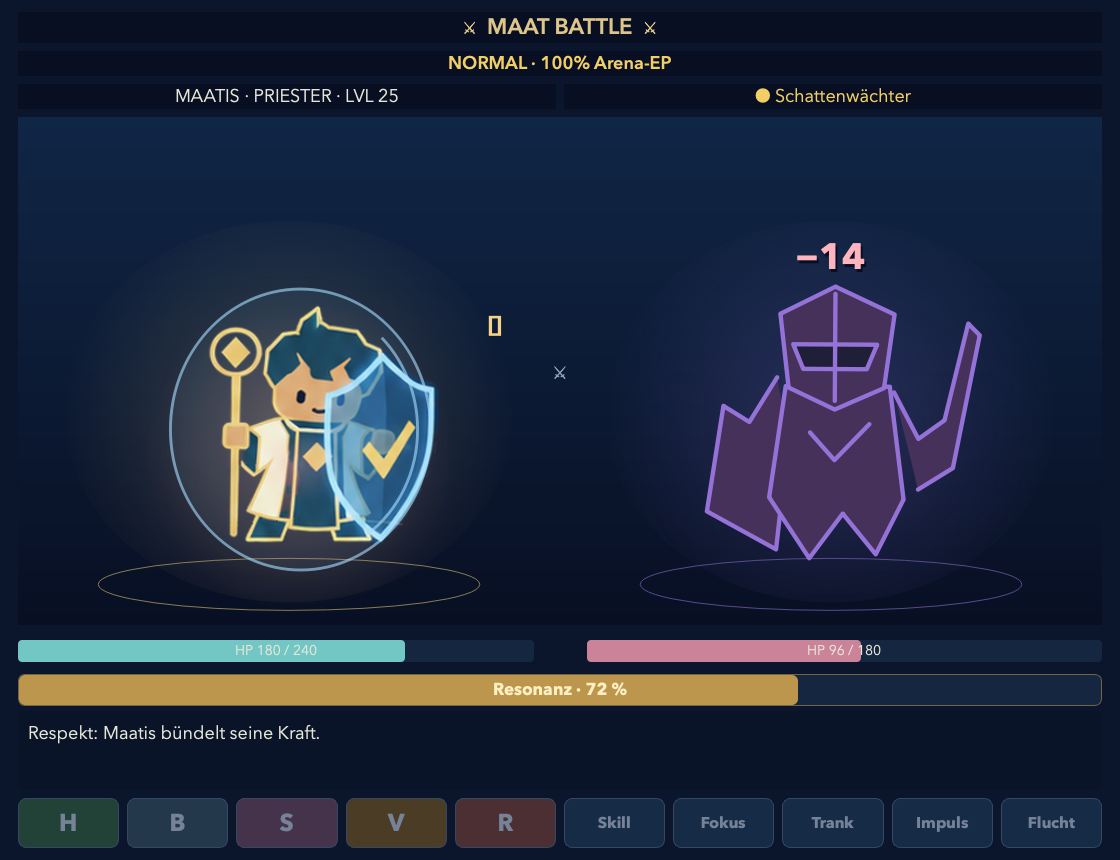
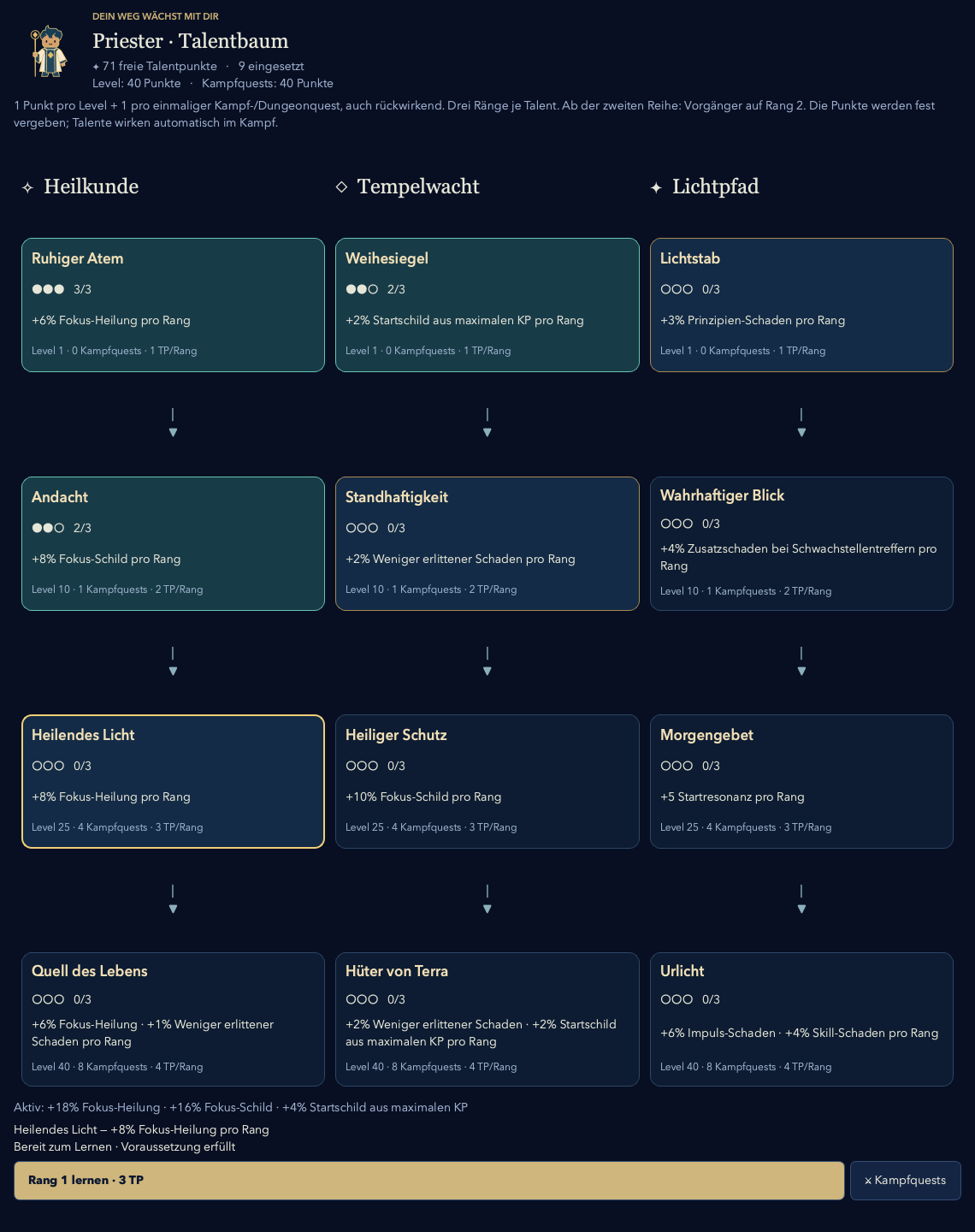
With a light robe and a staff, Maatis follows the Priest’s path. His talents emphasize Focus healing and shields. The Path of Light adds offensive options.
Priest suits a measured approach using Focus followed by counterattacks. Protection and healing talents can be especially useful when facing several battles in a row, as in dungeons.
One way to start: Calm Breath and Sacred Seal combine stronger Focus healing with a shield at the start of battle. Staff of Light is one possible first investment if you prefer an offensive opening.
Maatis puts on a dog costume, complete with floppy ears, paws and a mind of his own. Wild Spirit strengthens his attacks, Nimble Paws protects him, and Loyal Heart combines recovery with resonance.
Puppy offers a path toward powerful principle attacks and critical hits without neglecting protection. Learned talents can also improve Focus healing, resonance, skill damage and Impulse damage.
One way to start: Playful Bite and Pawwork combine stronger attacks with less incoming damage. Catch Your Breath is an alternative if recovery through Focus matters more to you.
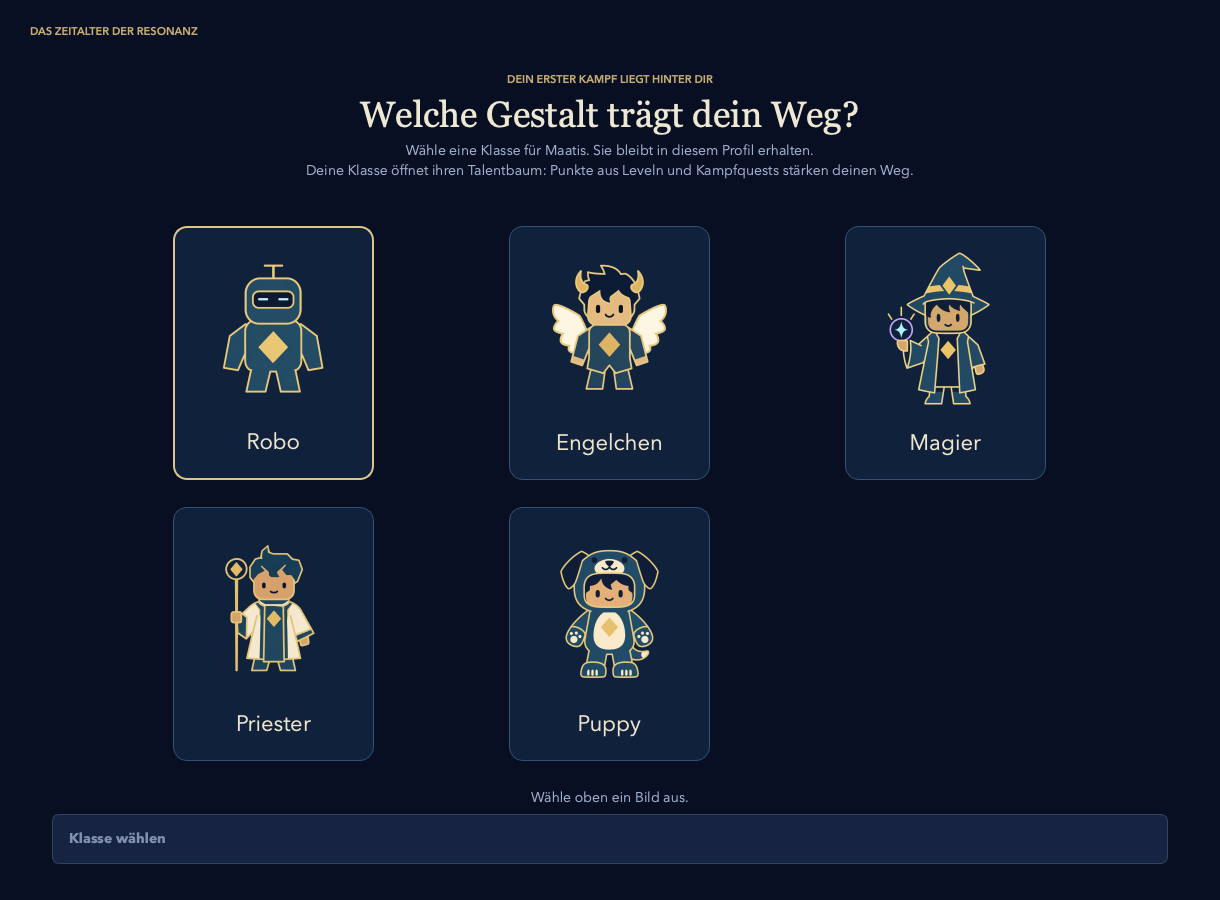
Maatis starts in his normal form. Class selection opens once combat mode is unlocked and you have fully completed your first real battle. The title-screen demo does not trigger class selection.
Choose an image and confirm your class. It stays with that profile permanently and unlocks its talent tree. Character portraits, combat artwork and the title-screen demo then follow your chosen class.
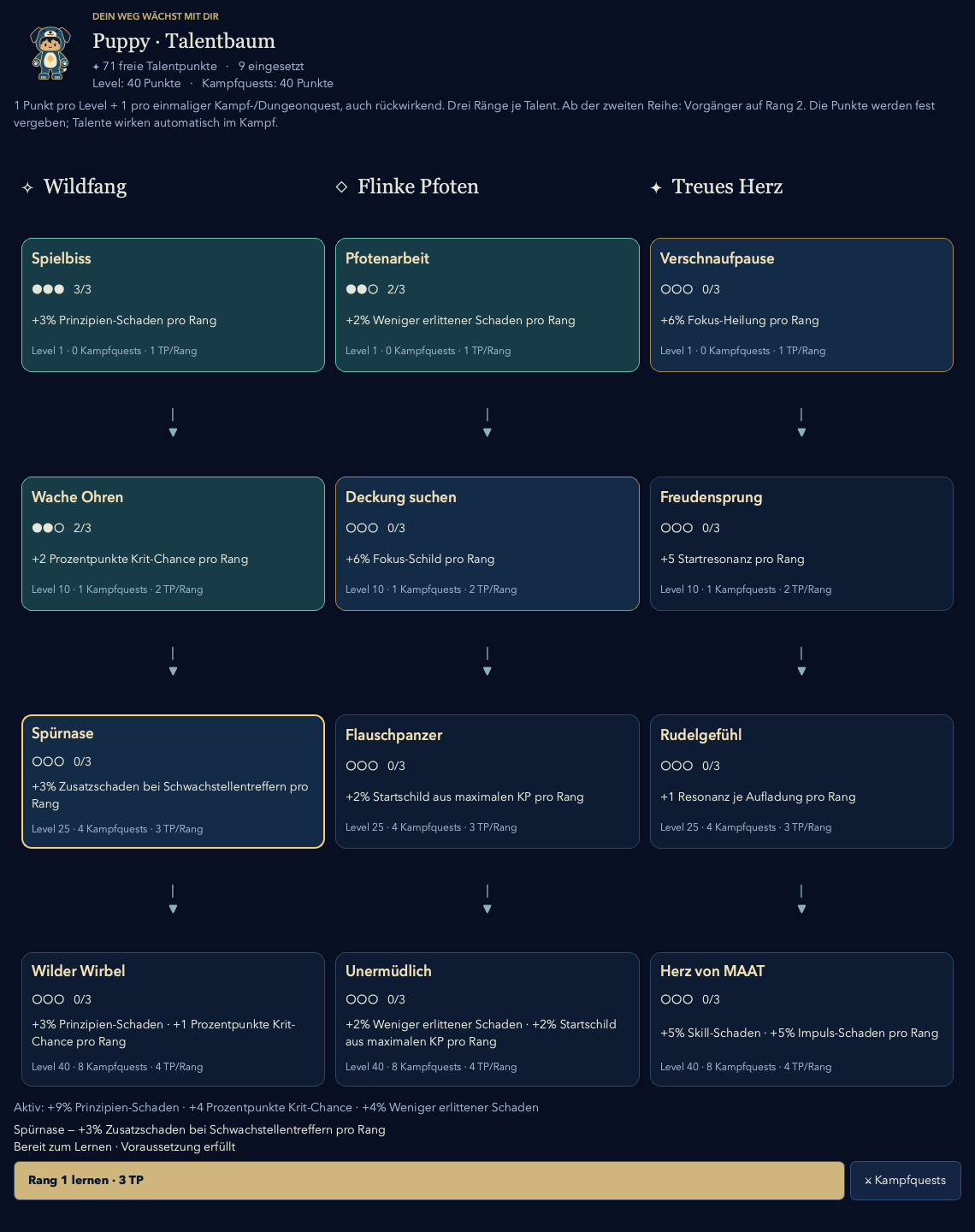
Each of the five classes has twelve talents across three branches. Every node can be upgraded through three ranks: 60 distinct talents for five styles of play.
You receive one talent point per level reached and another for each completed, non-repeatable combat or dungeon quest. Previous progress counts too.
Higher tiers require levels, completed quests and learned prerequisite talents. Costs and conditions appear on each talent. Allocated points are currently permanent.
Bonuses apply to real arena, random, boss, finale and dungeon battles. The title-screen demo remains a preview.
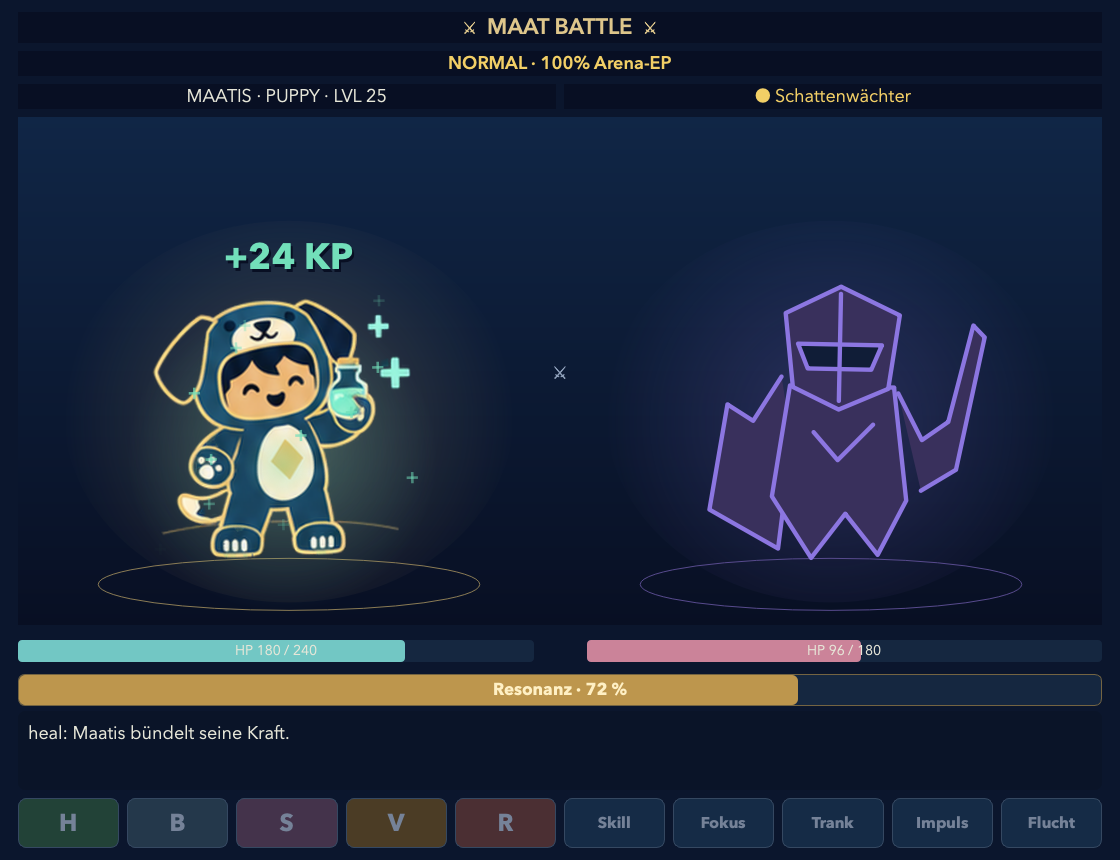
Use H, B, S, V and R, recognize weaknesses and choose between Attack, Skill, Focus, Potion and Impulse.
Attack artwork, ASCII effects, damage numbers and brief flashes make hits visible. The bar glows at full resonance.
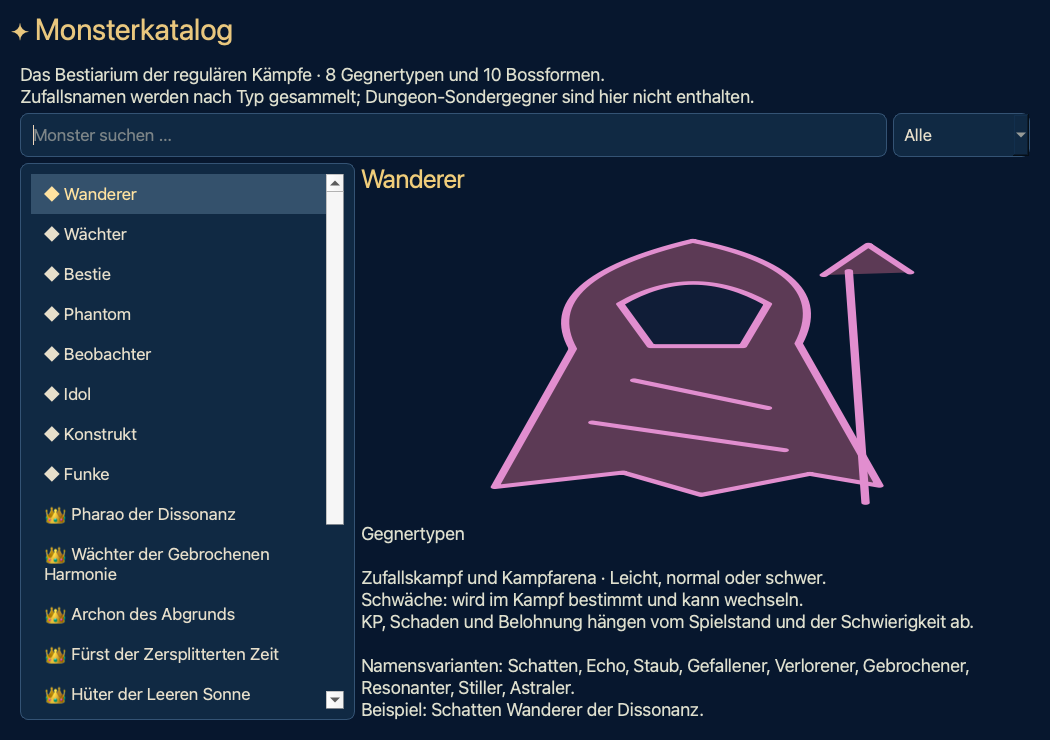
Green, yellow and red indicate enemy difficulty. Random encounters and arena battles vary in difficulty, with greater rewards for more demanding victories.
Random enemies are announced slowly in chat. The arena then opens, and after the battle you return to the Maatis tab. You can keep typing right away.





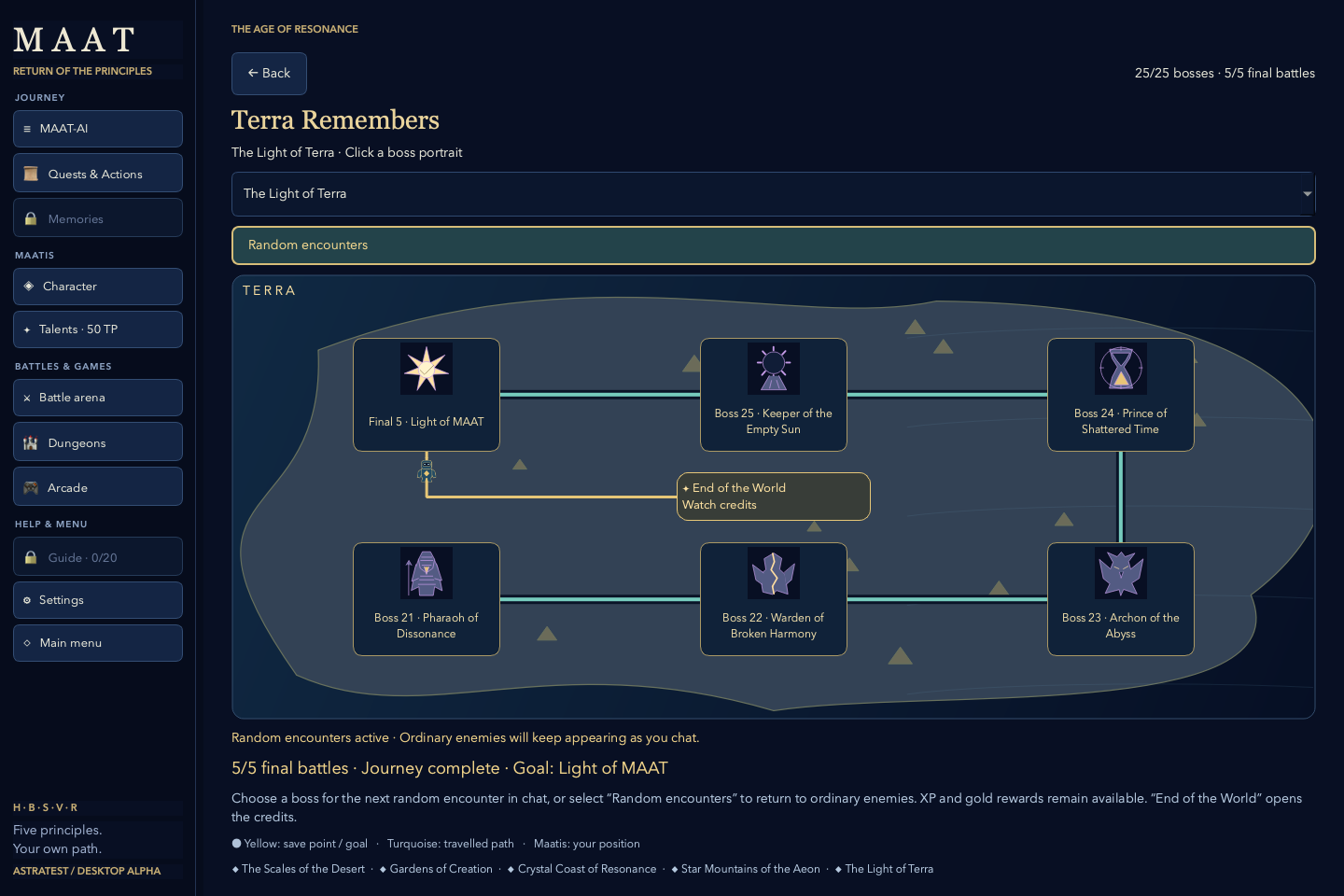
Maatis travels across the map as a game piece. Golden points mark destinations and save points; turquoise shows the path you have already traveled.
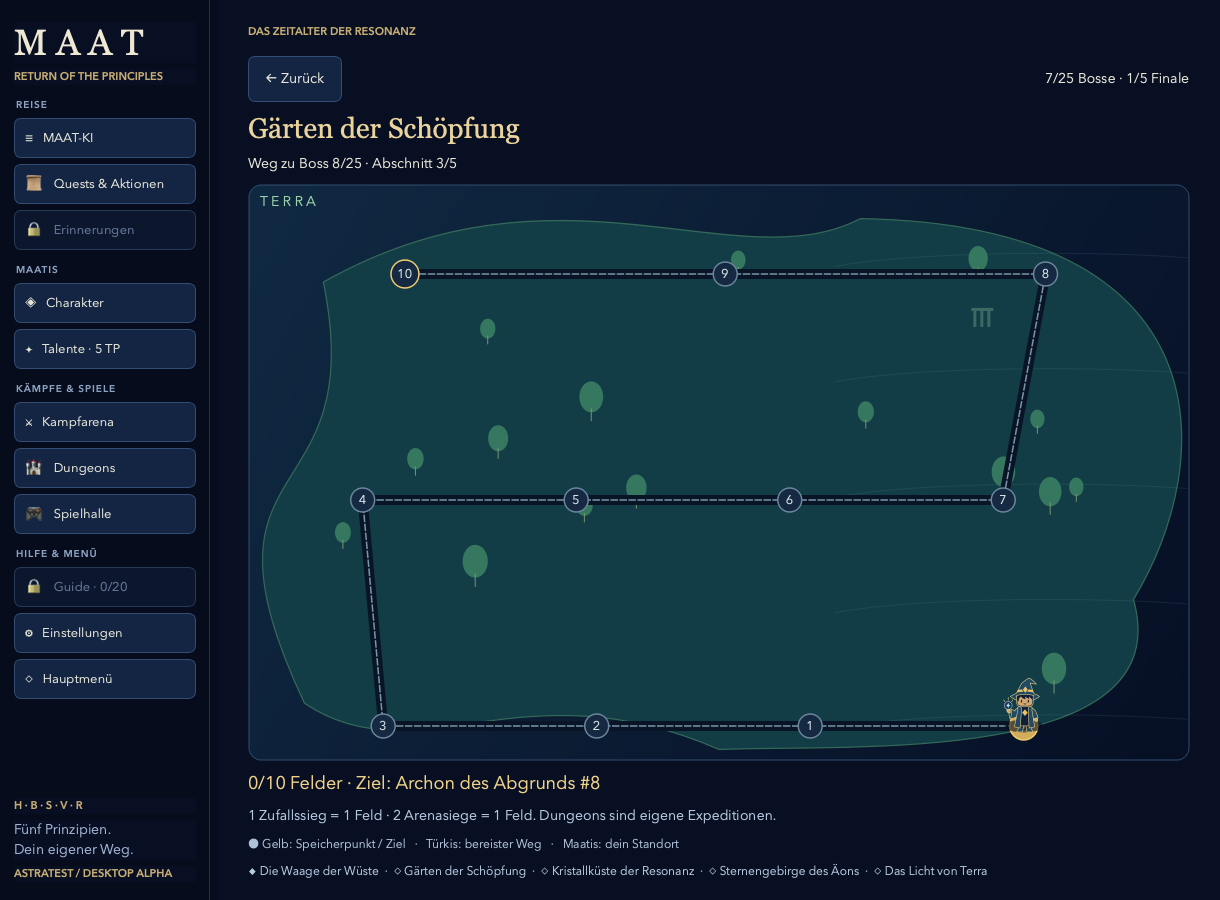
Until combat unlocks, Maatis advances one space with each story message. Your conversations set the journey in motion.
One random victory advances one space, as do two arena victories. A finale encounter awaits after every five defeated bosses: 25 bosses and five finales in total.
Losing to a campaign boss takes you back five map spaces. Losing to a finale enemy resets the approach to 0/10. Bosses and finales you have already defeated stay completed.
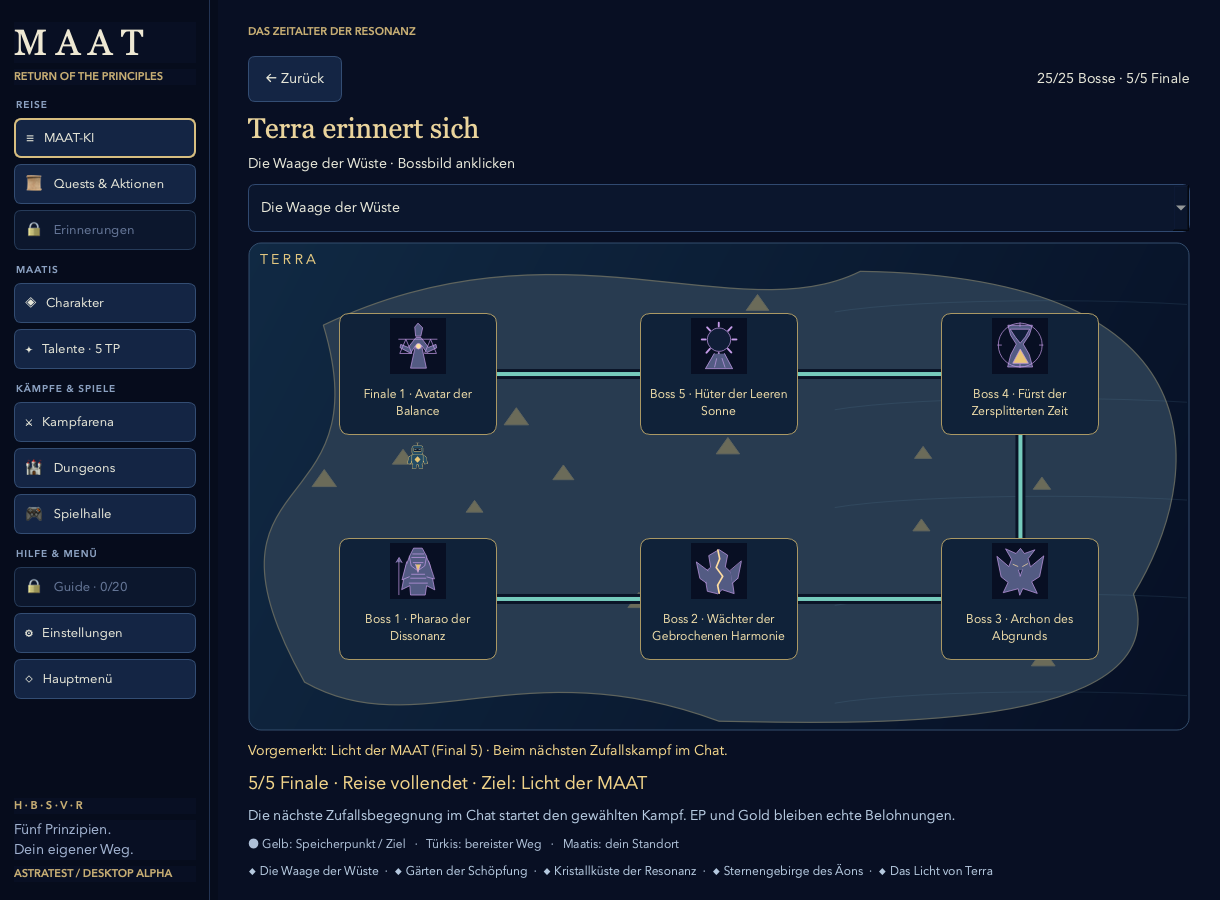
Click a boss portrait on the map. That opponent awaits in the next random battle actually triggered through chat, with the familiar slow announcement.
Repeat boss battles award rewards without advancing the completed story again. Arena battles and dungeons leave your queued boss choice intact.
Stories lead you from room to room. Four enemies and a stronger guardian await, accompanied by continuous music from the terminal dungeons.
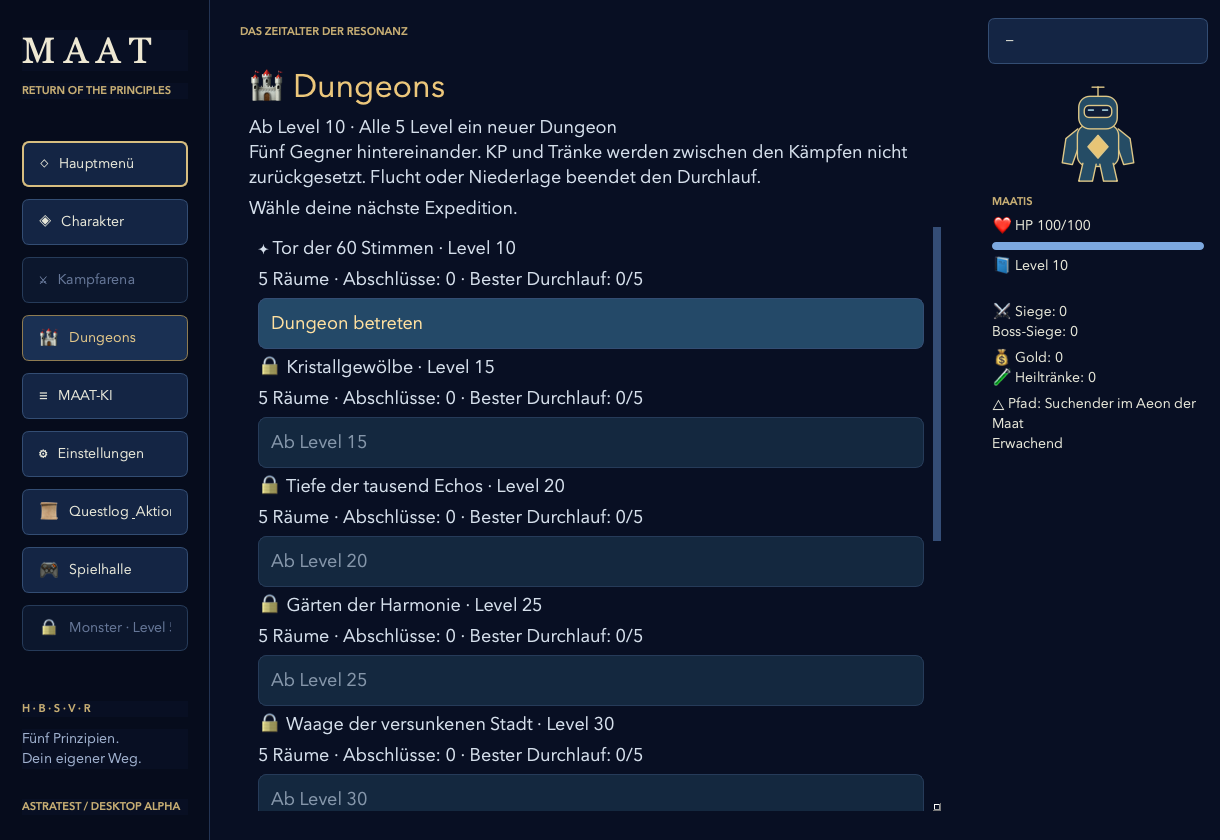
Your HP and potions carry through the entire run. Fleeing or defeat ends the expedition; rewards already earned remain yours.
Completed runs and the furthest room reached are saved. Later journeys lead through gardens, forges, bridges and the Hall of Respect to the Heart of the Five Principles.
After the nine named locations, deeper areas unlock every five levels. Music continues from the introduction through the battles without restarting for each enemy.
Gate of the 60 Voices
Crystal Vault
A Thousand Echoes
New locations every five levels
Heart of the Five Principles
Another enemy waits behind each one you defeat. Resistance grows with every wave. How far will your talent tree take you?
HP and potions carry through your entire run. Victories, rewards and your wave record are saved after each win. Fleeing or defeat ends the run.
The three dungeon music tracks play in sequence on a loop. Dedicated Dungeon+ quests reward long streaks and your total number of waves won.
Conversations, battles and small challenges come together in a growing saved adventure.
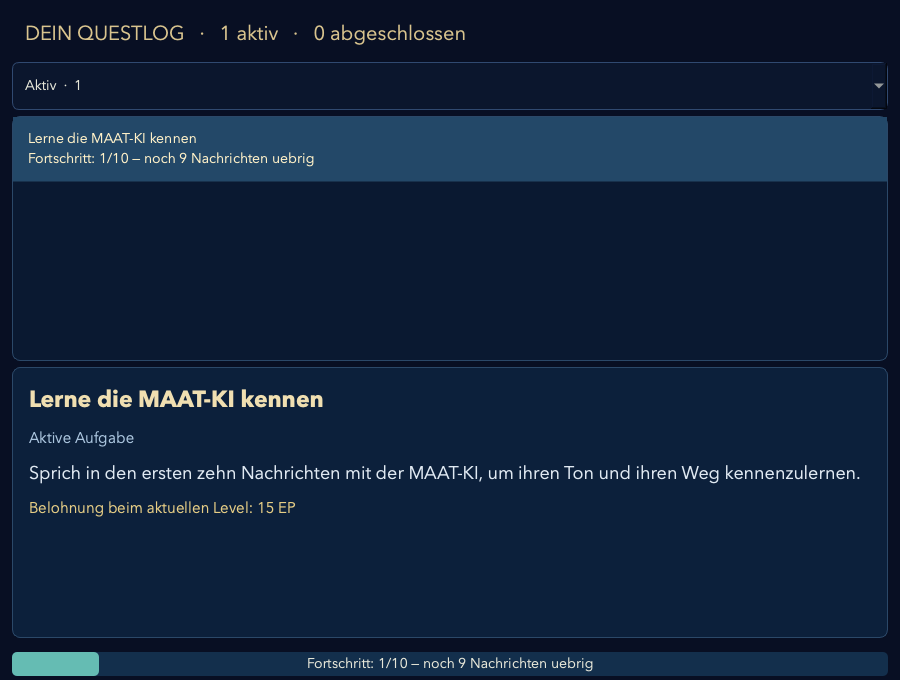
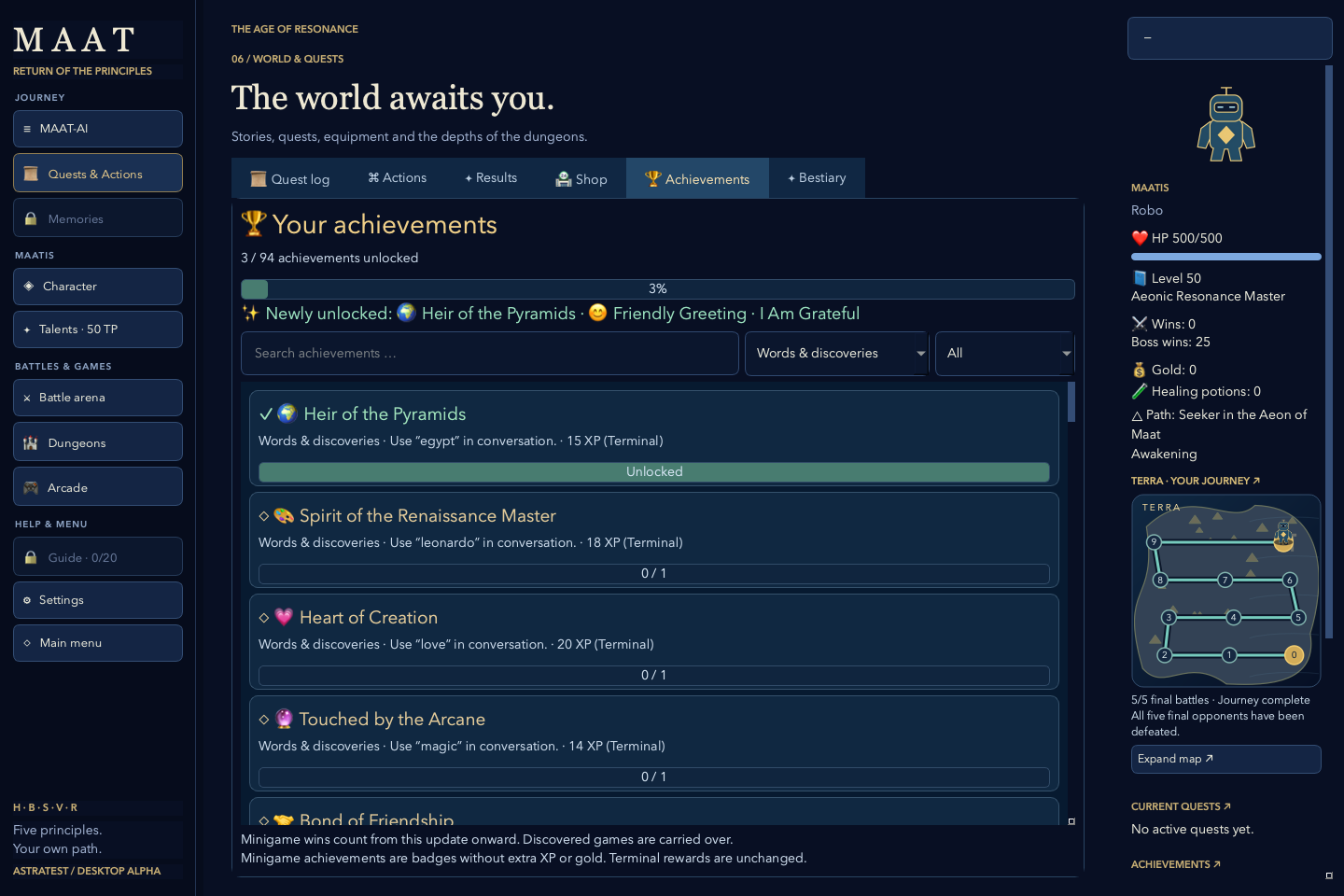
Track your tasks in the quest log. The campaigns accompany you through level 50; additional dailies and purchasable quest contracts extend the journey beyond it.
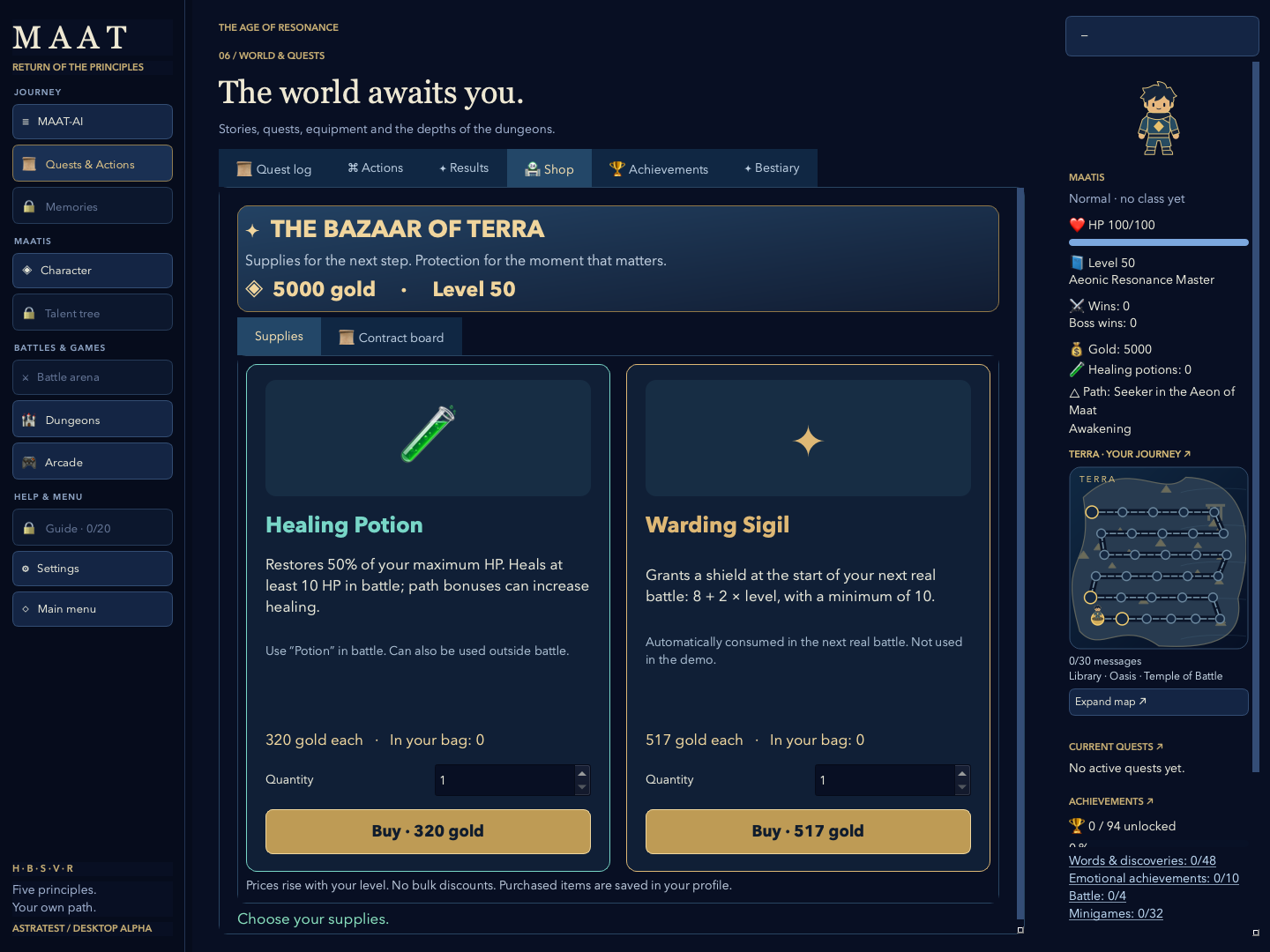
Buy items in the shop and prepare for the trials ahead. From level 50, you can also purchase new quest contracts.
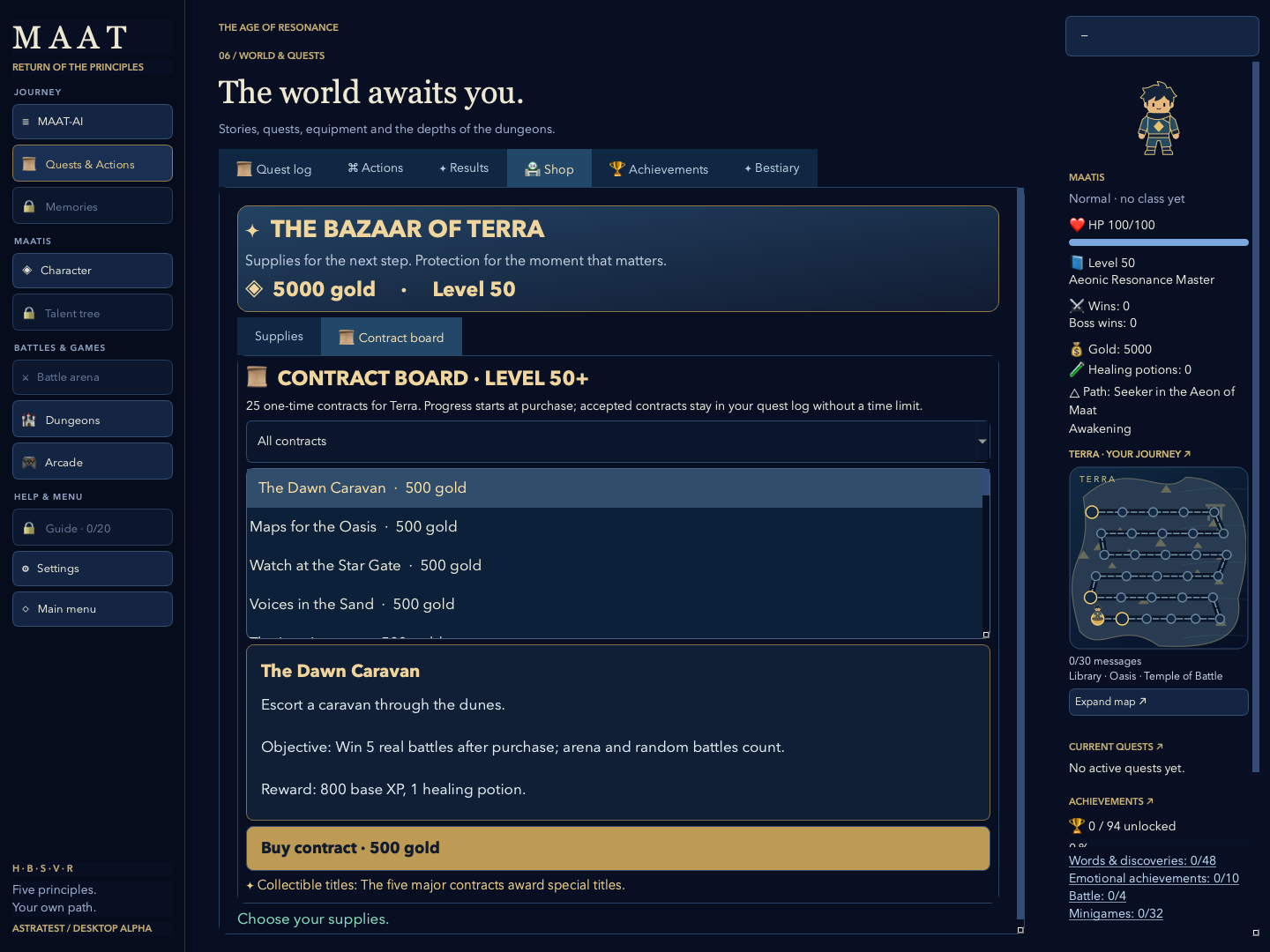
Invest gold in new goals. Dedicated tasks also reward combat victories, completed dungeons and Dungeon+ records.
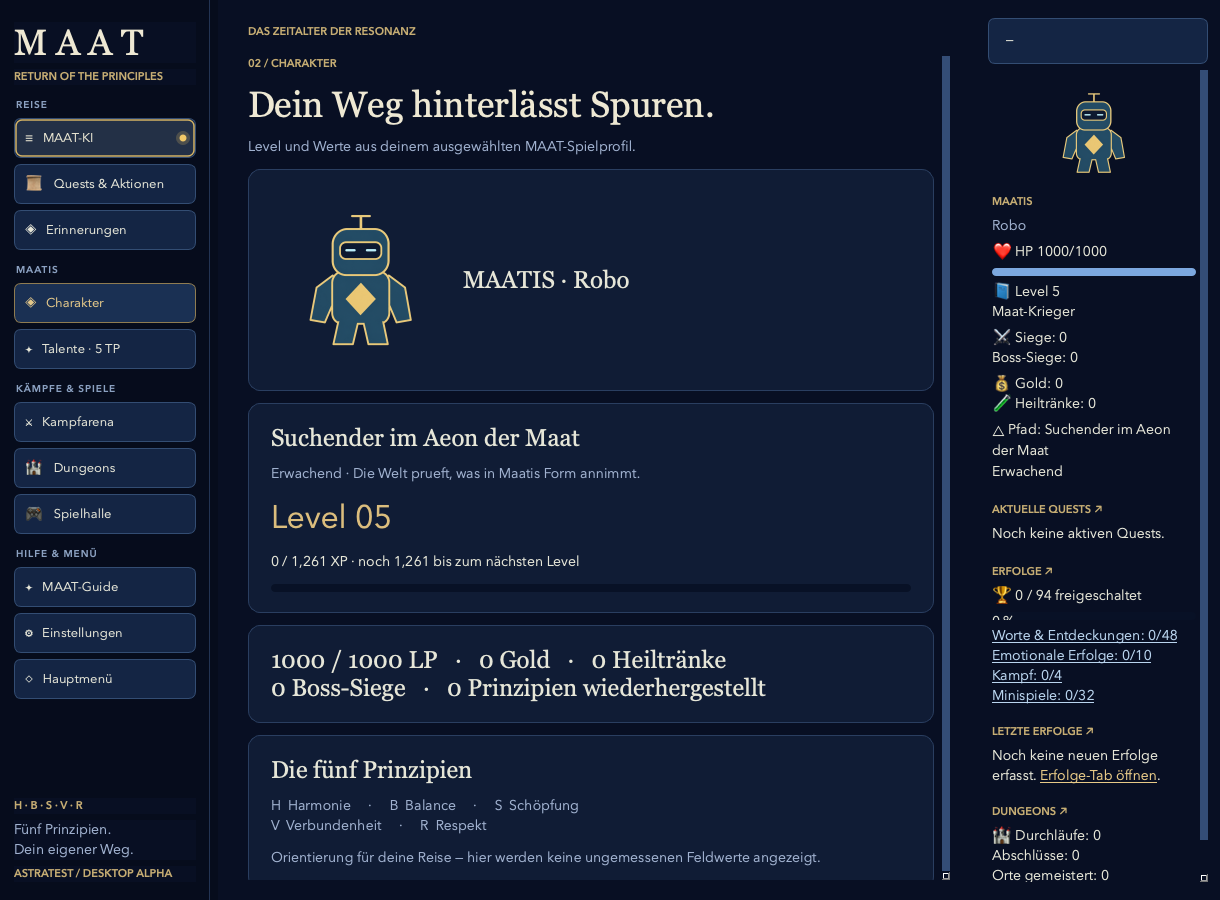
Up to five current quests display progress such as 3/10 in the expandable sidebar. Click an entry to open the matching quest.
Recent achievements, achievement statistics, dungeon completions and records are also within reach. The left navigation groups your journey, character development, battles and help.
The guide unlocks after 20 messages. It explains the five principles and offers a starting point for personal reflection. A MAAT score is a thinking aid, not an objective measurement of your personality.
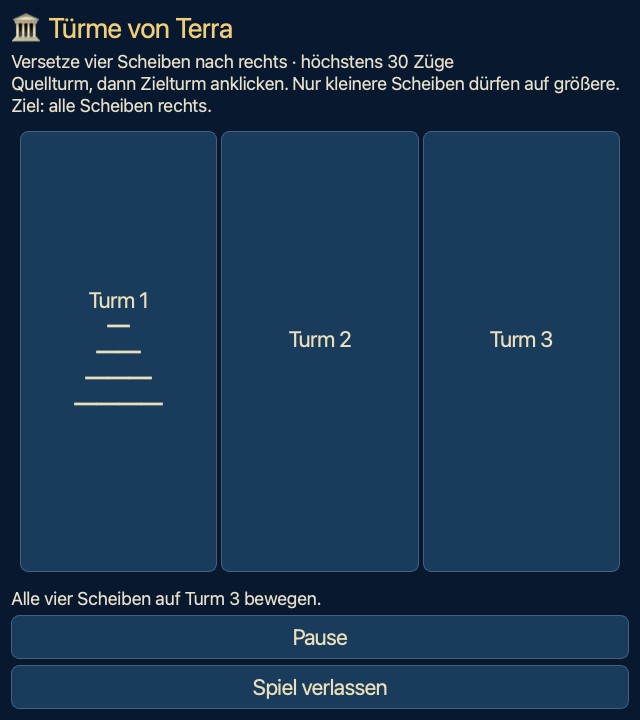
Skill, puzzles and the five principles: minigames appear as surprises in chat, then become part of your collection.
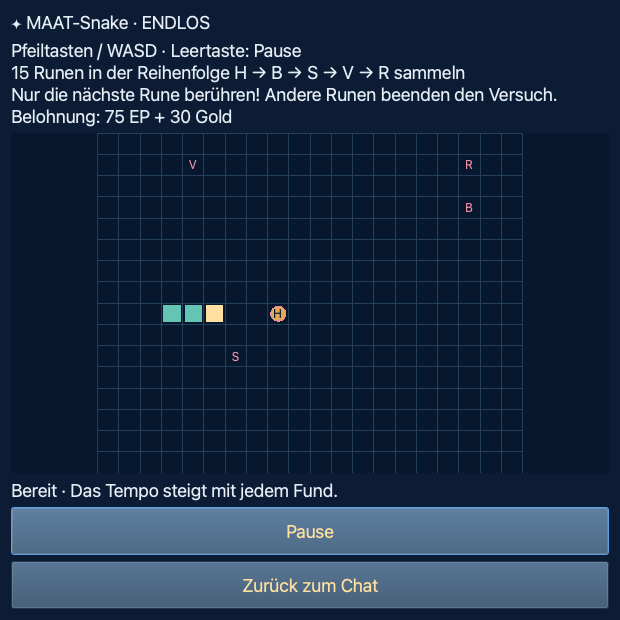
Snake with temple walls, Breakout, Tetris, Wheel of Fortune, Rune Pairs, Resonance Arithmetic and many more.
Chat challenges give you two attempts. A win earns XP and gold. In the arcade, play freely for high scores and achievements, with endless play available in selected games.
Your first minigame can appear at this point. After that, an offer arrives every five messages, or every thirty once combat mode unlocks.
A game found in chat permanently unlocks in that profile’s arcade. Everything runs inside the RPG window.
High scores fit each game: more fruit and rows, or fewer moves in puzzles. Music accompanies your attempt and stops when it ends.
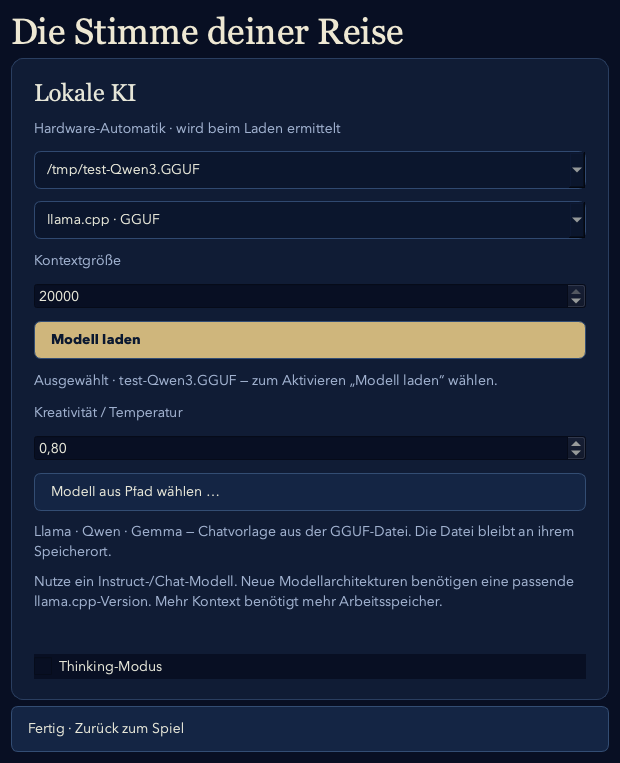
Choose a local GGUF model in the AI menu or through the file picker. Your selection is saved and used again the next time you start the game.
A progress bar shows the model loading. Adjustable font sizes, music volume and optional speech output let you tailor the experience.
Automatic hardware settings account for macOS on Intel and Apple Silicon, Linux and Windows, as well as your available AI backend. Response generation uses around 80 percent of available CPU threads. Native thinking output is off by default. The separate MAAT Thinking plugin is on by default and supplies an internal reflection instruction before the answer. If a model cannot load, the game displays an error message.
“Hide game context” keeps additional story and combat data out of the conversation. For Llama, this setting is always enabled; relevant memories and offline knowledge remain available.
Browse conversations by day, find important notes and decide what stays saved.
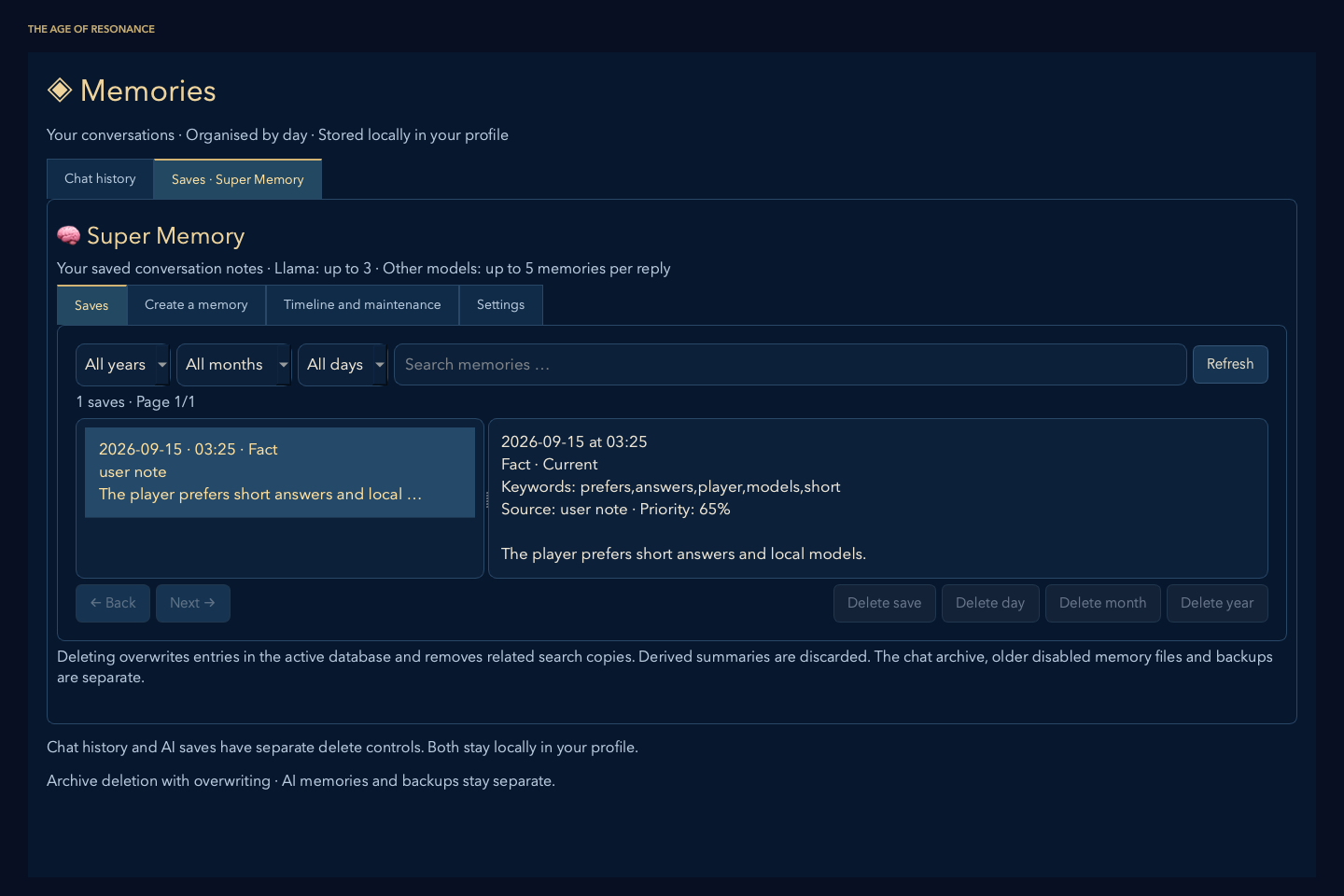
The chat archive organizes your conversations by day. Month and year filters help you look back. In the saves area, you can also create your own memories and search by keyword.
“What did I say the day before yesterday?”, “on June 15, 2026?” or “last month?” — in English or German. The AI searches relevant saved memories; that selection does not automatically include every entry in the separate chat archive.
Llama receives at most three relevant memories per request; Qwen, Mistral, Gemma and other models receive at most five. Memory roles also follow the “I am the AI” perspective.
Select a local ZIM file in settings. The offline wiki can supply relevant article excerpts about people, places and topics, including questions such as “Calculate the MAAT score of the Mona Lisa.” Available information depends on the contents of your file.
Excerpts are kept short, especially for Llama. Regular conversation remains available without a selected ZIM file.
Recent screenshots show classes, talents, memories and the world map. Story illustrations and some earlier views round out the journey; visible game values come from test profiles.
The main calculations from the current game prompts: plain explanations and explicitly chosen numerical examples. Start with the small MAAT calculator on the home page.
MAAT = (H + B + S + V + R) / 5Keep all ratings on the 0–10 scale. For example: Harmony 5, Balance 6, Creative Power 7, Connection 8, Respect 9. Their sum is 35; divide by 5 to get 7 out of 10. The reasons behind the individual ratings matter as much as the number.
Stability = min(R, ⁴√(H × B × S × V))First divide every rating by 10: 5 becomes 0.5. Multiply Harmony, Balance, Creative Power and Connection, then take the square root twice. The smaller of this result and Respect is Stability. Five ratings of 5 give 0.5, or 5 out of 10. A low value brings the result down; Respect also sets an upper limit.
Maat_world = P / ΔEP is the product of all five principles after conversion to 0–1; ΔE represents disorder here. Five values of 0.5 give P = 0.03125. With ΔE = 0.5, the result is 0.03125 / 0.5 = 0.0625. The idea: stronger connection and less disorder raise the model index. This is not a score out of 10. The extended version P / (ΔE + ΔQ) also includes uncertainty ΔQ.
PLP = P × K / (O + ΔE)K means competence, O obstacles and ΔE energy effort in this formula. The principles product and competence form the numerator; obstacles and effort form the denominator. Example: P = 0.03125, K = 0.8, O = 0.5 and ΔE = 0.5 give 0.025. The idea becomes visible: skills help, while obstacles and effort slow progress. Again, this is a model index, not a score out of 10.
C(x) = P / (ΔE + ε)This simplified game notation describes coherence at a location. ΔE means disorder; ε is a small positive safeguard number. Example: P = 0.03125, ΔE = 0.49 and an explicitly chosen ε = 0.01. This gives 0.03125 / 0.5 = 0.0625. The safeguard affects the result and must be stated.
Index = P × C × M / (ΔI + ΔE + ΔD)Both use the same calculation in the game. C means collective coherence, M memory, ΔI instability, ΔE disorder and ΔD dissonance. With P = 0.03125, C = 0.8, M = 0.5 and burdens of 0.2 + 0.5 + 0.3, the result is 0.0125. The name AGI_proximity does not establish a measured proximity to general AI; AI_CONSCIOUSNESS does not demonstrate consciousness.
MAAT_MASTER = P × K × C / (ΔE + ΔQ + ΔI + ΔD + ε)K means competence and C collective coherence. The denominator combines disorder, uncertainty, instability, dissonance and an explicitly chosen safeguard. Example: 0.03125 × 0.8 × 0.5 divided by (0.4 + 0.2 + 0.2 + 0.19 + 0.01) gives 0.0125.
B_universe = ∫ [P / (ΔE + ΔQ)] d⁴xThe integral adds contributions across space and time. Imagine many small spacetime cells: calculate P / (disorder + uncertainty) in each cell, multiply by its size and add the contributions. A purely numerical example with constant values: 0.03125 / 0.5 = 0.0625; for a total region of 2 spacetime units this gives 0.125. Without defined fields, units and a region, it cannot provide a value for the actual universe.
These numbers are subjective assessments within a model. They do not measure a person’s worth or scientifically established laws of nature. The game calculates combat XP, HP and resonance separately.
On the very first launch, choose your language. The title screen then appears with music; starting the game opens profile selection. Your saved model loads, or you select a GGUF file. A new game starts with the intro; then you choose the Maatis or AI perspective. Class selection follows only after combat unlocks and you complete your first real battle.
This page introduces the desktop game. It contains images and a feature overview; the game itself runs in the MAAT RPG application.
The current macOS package supports Intel and Apple Silicon on macOS 13.3 or later. The desktop interface uses Python and Qt. The architecture also accounts for Linux and Windows, which need their own suitable runtime, audio and AI packages and further testing.
Both the website and game are available in English and German. Choose the game language before the very first title screen. Your choice is remembered and can be changed in settings. Menus, stories, achievements, shop, memory notifications and enemy names follow the game language.
In regular play, Maatis remains at a minimum of one HP. Conversations can help him recover. A dungeon run ends when you lose or flee. A boss defeat takes you back five map spaces: five random victories or ten arena victories bring you back. A finale defeat still requires ten spaces. You can combine both battle types. Completed campaign sections remain intact. Optional boss rematches after the ending do not reset the campaign.
Five principles. Two perspectives. Your own path.
Back to the beginning ↑