Structural Selection · Dynamic Fields · Observable Cosmology · 2026
Version 10 · Dynamic Structural Selection in Cosmology

MAAT Dynamic Structural Selection

A complementary layer for physics: standard dynamics determines what is possible, while structural selection ranks what remains coherent enough to be realised.

Dynamics makes possibilities. Structure selects persistence.
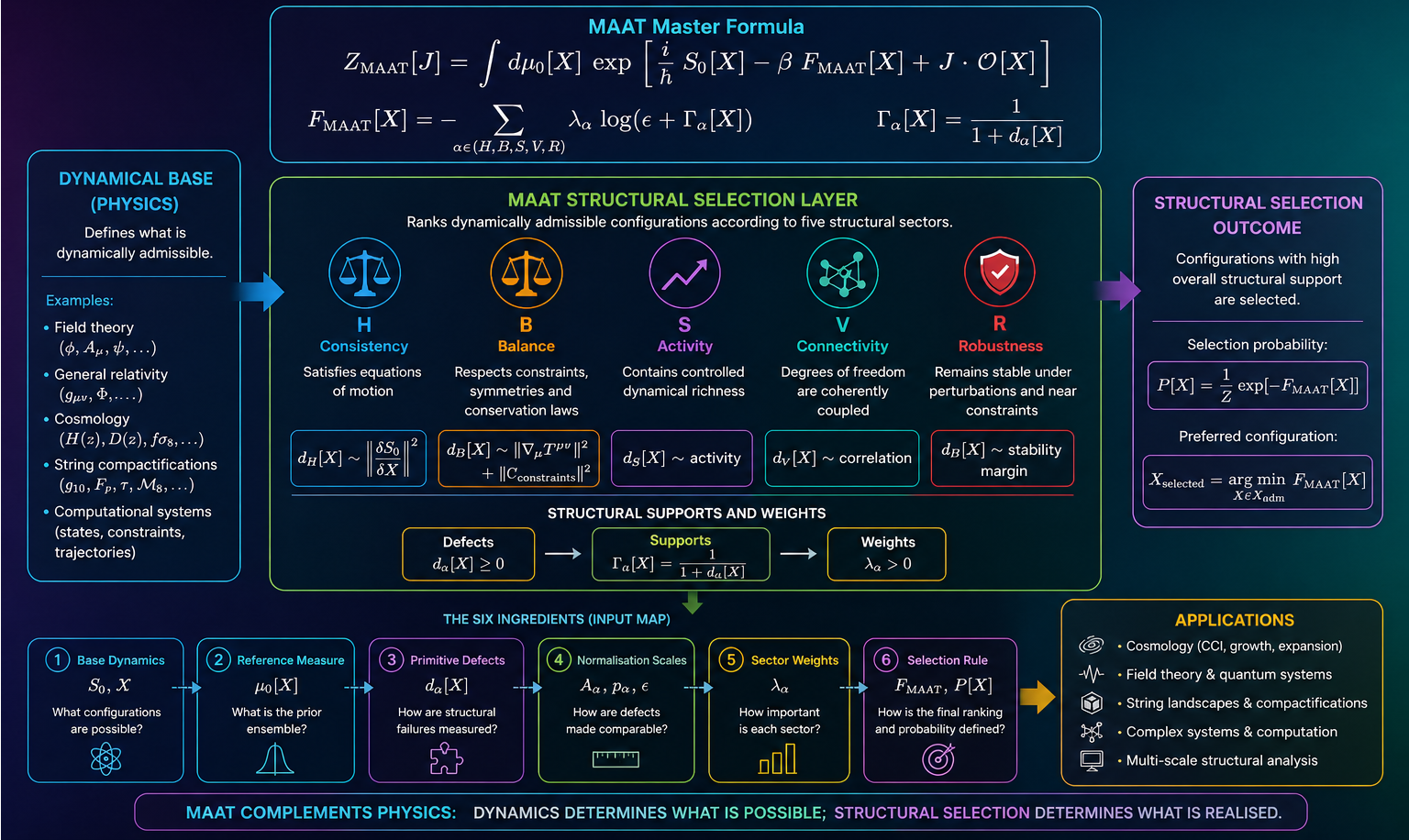
Diagram of the MAAT Structural Selection Principle with dynamical base, master formula, structural selection layer, outcome, ingredients, and applications.
The MAAT Structural Selection Principle as a full input map: dynamics, reference measure, primitive defects, normalisation, sector weights, and selection rule.
31H(z) chronometer points
15.3661fixed MAAT χ²
0.5299best reduced χ²
581/616stable scan branches
Plain language

The core idea

Imagine the universe as an orchestra. Cosmology tells us the tempo: how fast the universe expands. MAAT asks a second question: are the instruments still playing together coherently?

In technical language, MAAT adds a structural selection layer on top of ordinary dynamics. It does not replace field theory, general relativity, or ΛCDM. It asks which dynamically admissible configurations have enough internal support to persist.
Why it matters

From idea to testability

The dynamic MAAT programme turns structural weights into response fields, couples them to effective cosmology, and then computes observables. That makes the framework falsifiable: it can now be compared with data.

defects
d_a
covariance
C_ab
response
λ
cosmology
H(z)
data
χ²

The five structural sectors

MAAT evaluates configurations through five complementary structural supports.

H

H · Consistency

Does the configuration satisfy the equations or internal rules of the system?

B

B · Balance

Are constraints, symmetries, and conservation-like relations respected?

S

S · Activity

Is there controlled dynamical richness rather than frozen or chaotic behaviour?

V

V · Connectivity

Are the degrees of freedom coherently coupled instead of fragmented?

R

R · Robustness

Does the configuration remain stable under perturbations and near constraints?

Master formula

The selection layer

MAAT starts from ordinary dynamics \(S_0\) and adds a structural cost \(F_{\mathrm{MAAT}}\). Lower structural cost means stronger support.

\[ Z_{\mathrm{MAAT}}[J] = \int d\mu_0[X]\, \exp\left[ \frac{i}{\hbar}S_0[X] - \beta F_{\mathrm{MAAT}}[X] + J\cdot O[X] \right] \]
Structural support

The MAAT cost

Each sector contributes a defect \(d_a[X]\), converted into a support factor \(\Gamma_a[X]\). The weights \(\lambda_a\) set how strongly each sector shapes the final ranking.

\[ F_{\mathrm{MAAT}}[X] = -\sum_{a\in\{H,B,S,V,R\}} \lambda_a \log(\epsilon+\Gamma_a[X]), \qquad \Gamma_a[X]=\frac{1}{1+d_a[X]}. \]

From structural selection to cosmology

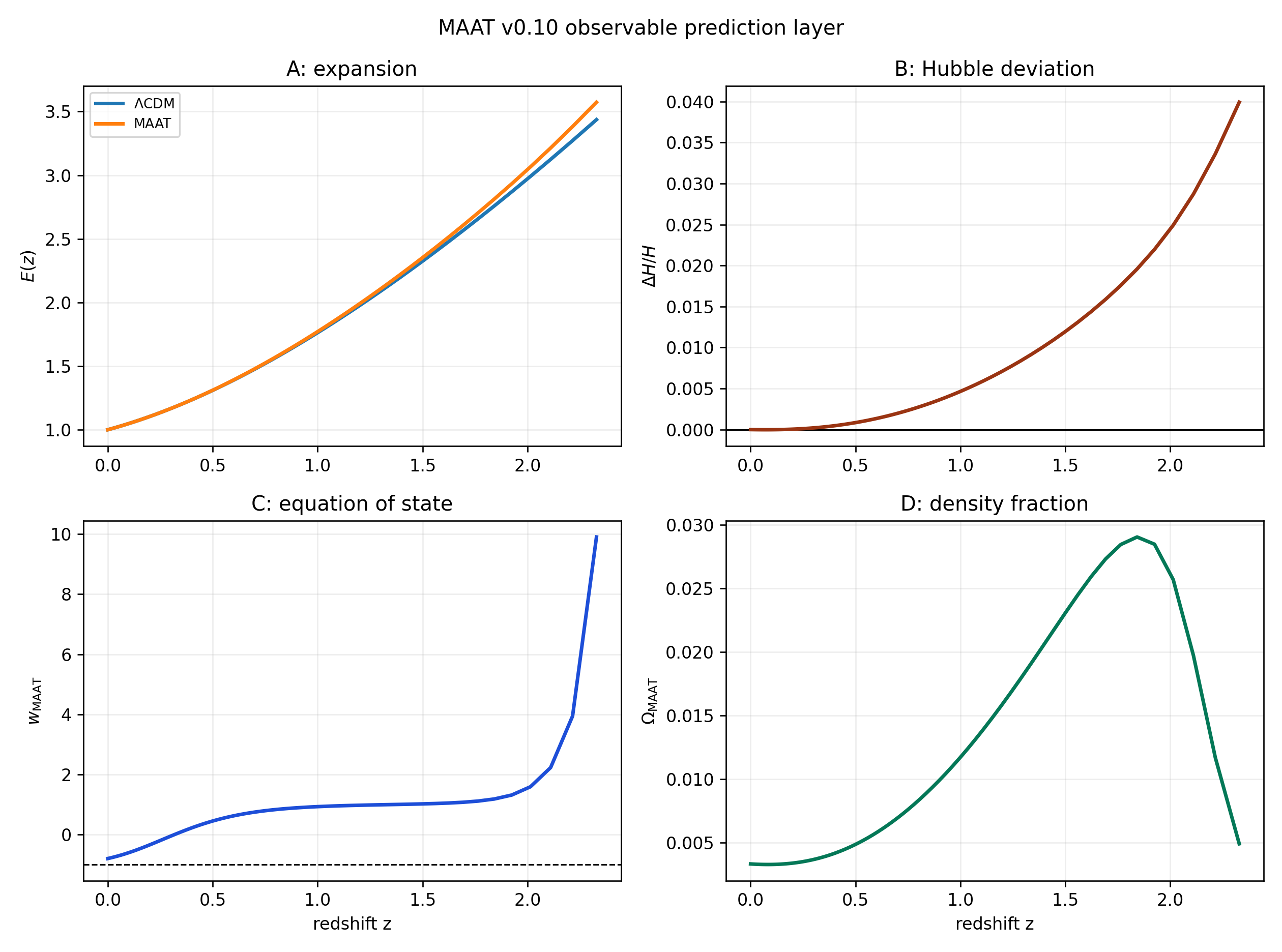
The current application computes observable expansion and growth proxies from the stable MAAT scalar branch.

Expansion

H(z)

The model predicts an expansion curve that can be compared directly with chronometer data.

3H² = ρ_m + ρ_r + ρ_Λ + ρ_MAAT
Dark-energy-like sector

w(z) and ΩMAAT

The MAAT contribution remains small and behaves as a subdominant effective sector.

w_MAAT = p_MAAT / ρ_MAAT
Structure

Growth proxy

The framework also prepares a route toward growth observables such as fσ8.

ΔH/H = (H_MAAT-H_LCDM)/H_LCDM
Four-panel summary of MAAT observable predictions: Hubble history, relative deviation, equation of state, and growth proxy.
Observable prediction layer: expansion history, relative deviation, equation of state, and growth proxy.
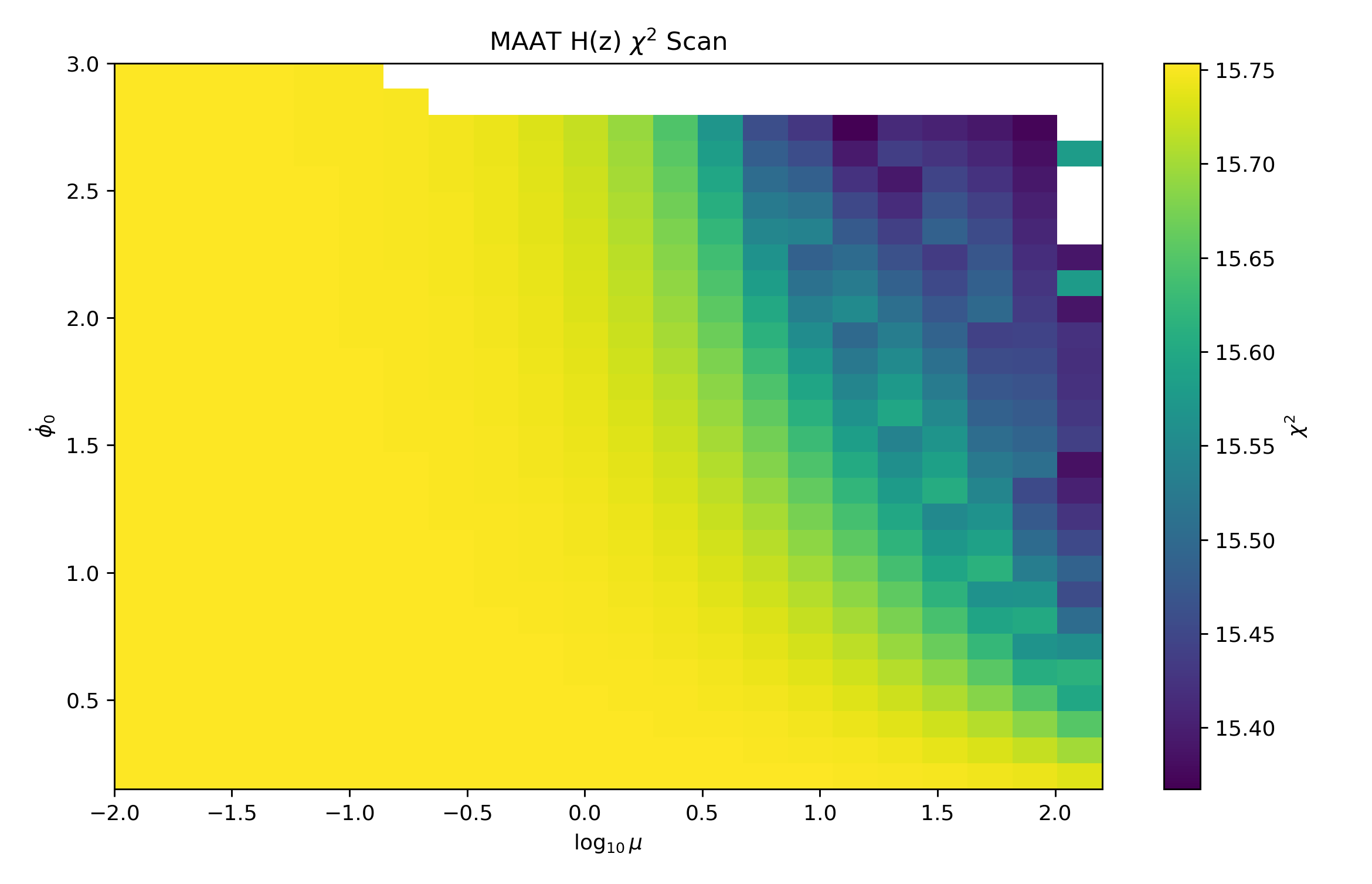
Chi-square heatmap over MAAT parameter scan.
Paper 32 parameter scan: stable branches are evaluated by chronometer chi-square.

First data contact: the H(z) test

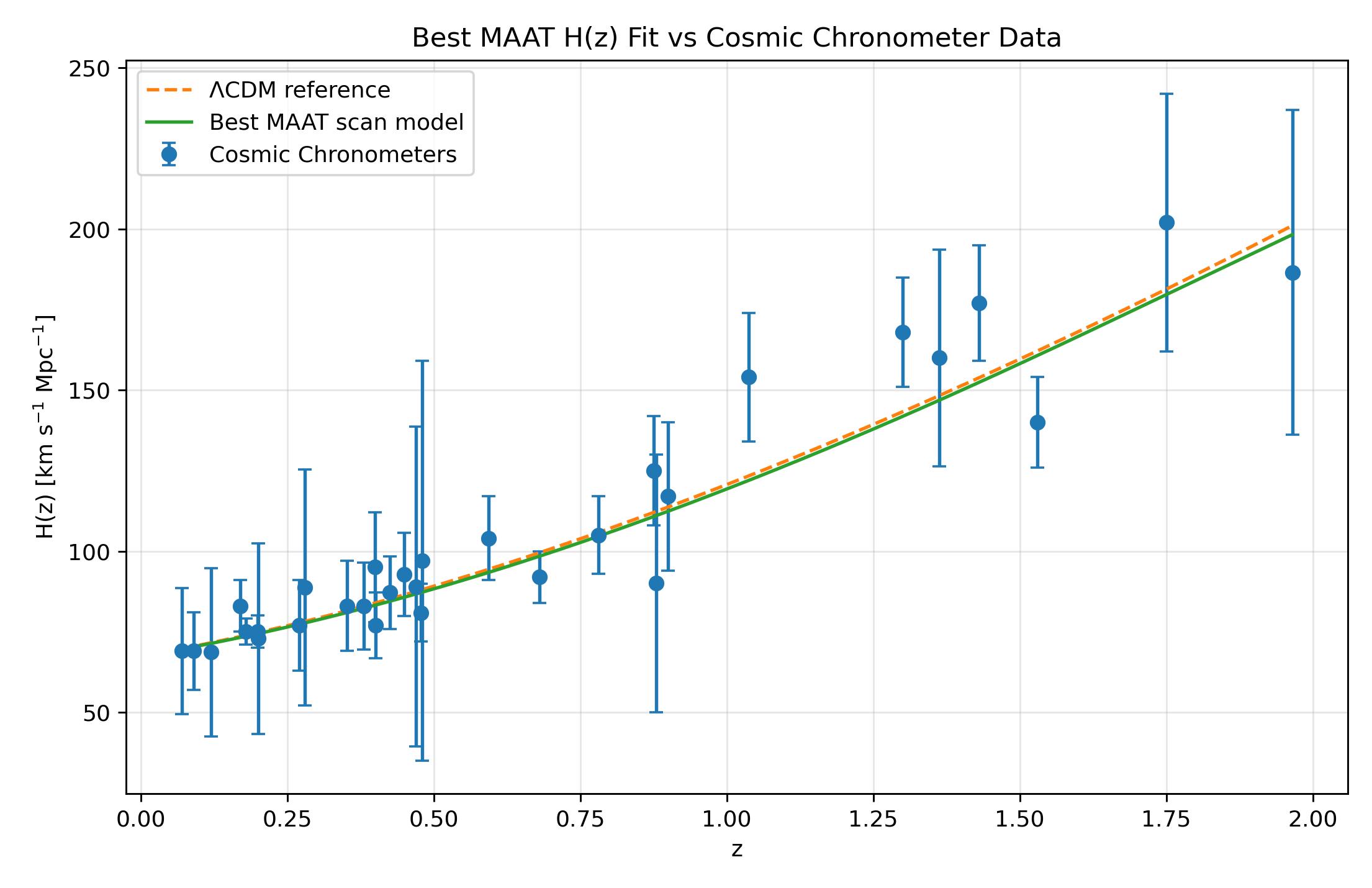
Paper 32 compares the MAAT expansion branch with 31 Cosmic Chronometer measurements.

Result

Close to ΛCDM, but not favoured

The conservative reading is important: MAAT survives this first diagnostic contact with H(z) data, but it does not outperform ΛCDM.

14.8759ΛCDM χ²
15.3661fixed MAAT χ²
0.5299best reduced χ²
581/616stable scan models
Best MAAT H(z) fit compared with Cosmic Chronometer data and Lambda-CDM.
Best stable MAAT scan point compared with Cosmic Chronometer H(z) data.
Scientific status

What this is

  • A structural selection layer added on top of standard dynamics.
  • A reproducible effective-theory pipeline from defects to observables.
  • A first data-facing benchmark using H(z) chronometer measurements.
Scientific boundary

What this is not

  • Not a replacement for ΛCDM.
  • Not evidence for modified gravity.
  • Not a completed precision cosmological fit.